Showing posts with label WWII Movies. Show all posts

28/07/2014

TIME FOR A GOOD MOVIE - THE RAILWAY MAN (2014)


It is impossible not to think of war these days. Press and TV news keep our minds and hearts in constant worry. Though I usually avoid writing or discussing breaking news or politics here on my blog , today I’m going to tell you about  this beautiful movie I have just seen, with all my heart to the news coming from the several open fighting fronts.

War is no game. War leaves a mark. Eric Lomax , like many other surviving soldiers,  lived haunted by his war memories all his life through, as if war never actually ended in his mind and his heart. The Railway Man, based on Lomax’s autobiography,  will come out in September 2014  here in Italy as “Le due vie del destino”, but it opened theatrically on New Year’s Day in the UK and , in the US,   in April 2014.  It is already available on DVD at amazon.co.uk and,  from August 12,   it will be at amazon.com too.

05/05/2013

ANITA B. - ROBERTO FAENZA DIRECTS ROBERT SHEEHAN AND ELINE POWELL

Robert Sheehan  and Eline Powell as Eli and Anita
Roberto Faenza has started shooting his new film, Anita B.,  in Bolzano, Italy, with an international cast: Robert Sheehan, Eline Powell, Antonio Cupo, Nico Mirallegro are among the young protagonists. The movie is based on a novel by Edith Bruck (read about her HERE), titled Quanta stella c'è nel cielo, which,  for what I know, hasn't been translated into English so far. 

The book

Edith Bruck won the Premio Viareggio Narrativa 2009 for  «Quanta stella c'è nel cielo». There's no grammar mistake in the title. It was just meant to sound "How much star is there in the sky" in the quoted line of Sàndor Petöfi's ballad.  
Anita (Eline Powell) , who's  only 16,  has just the great Hungarian poet's  lines to warm her heart and little else sweet left in her mind.  She keeps so many ripping memories inside herself, memories nobody wants to listen to.  She survived the concentration camp, is beautiful and sensitive, life trials have tattoed her soul forever. She's running away from a Hungarian orphanage to join her aunt, Monika. 

03/08/2011

PERIOD MOVIES RECENTLY WATCHED

Watching period drama or costume movies is one of my favourite pastimes and being on holiday helps a lot! I've recenlty watched several films, these are just three of them, all of them set  around the years of WWII: BBC 2 The Night Watch (2011) , Miss Pettigrew Lives for a Day (2008) and Within the Wirlwind (2009). 

The Night Watch  - I was in England when it was on BBC2 on 12 July and could see it while in Nottingham. My attention was caught by the first scenes showing Anna Maxwell Martin (Bleak House, North and South, South Riding) in men's clothes wandering about the crowded streets of London as haunted. So I decided to go on watching though I didn't know anything about it. 
 
"If you go to the cinema midway through a film, you watch the second half first, don't you?" Kay - the character Anna Maxwell Martin plays - says at the beginning. The Night Watch then also unfolds from back to front, beginning in 1947, then jumping back to 1944, then again to 1941( it is just the same device used by Sarah Waters in the novel (2006) this TV movie is an adaptation of ).

10/06/2011

CONSPIRACY (2001) - AT THE TABLE OF DEATH

Conspiracy is a 2001 TV movie starring several  popular British actors such as Kenneth Branagh, Colin Firth, Brendan Coyle, as well as  American film stars like Stanley TucciIt dramatizes the 1942 Wannsee Conference. The film delves into the psychology of Nazi officials involved in the "Final Solution of the Jewish Question" during World War II. It is also a partial remake of the German film The Wannsee Conference (1984).
On January 20, 1942, 15 men gathered in a villa on the outskirts of Berlin for a clandestine meeting that would ultimately seal the fate of the European Jewish population. Ninety minutes later, the blueprint for Hitler’s Final Solution was in place. Adolf Eichmann prepared 30 top-secret copies of the meeting’s minutes. By the fall of the Reich, all had disappeared or been destroyed—except one. The Wannsee Protocol, found in the files of the Reich’s Foreign Office, is the only document where the details of Hitler’s maniacal plan were actually codified, and serves as the basis for Conspiracy.

15/04/2011

WHAT I'VE BEEN WATCHING - THE GLORIOUS '39 (2009)

As some of you might remember, I'm fond of WWII movies as well as of films set in older times. I had this 2009 DVD, THE GLORIOUS '39,  there waiting in my TBW list for quite a while. This is not "Schindler's List" nor "La Vita è Bella" nor "Agnes Gray" either. But it was quite an interesting discovery.
It seems this film  bears all the traditional hallmarks of Stephen Poliakoff obsessions: the evocative power of the past, the magic of memory, the mystical bonds of extended family connections, the hidden energies of secrets kept buried for too long, and the shattering consequences of the revelation of truth which has been suppressed. It is weird but original and well acted and, of course, with stunning locations, picturesque castles, hunting grounds, elegant gatherings. 

16/03/2011

LOVE BEYOND IDEALS - EDDA E IL COMUNISTA - I WATCHED IT ON ITALIAN TV

Stefania Rocca and Alessandro Preziosi

When Edda Ciano landed on Lipari shores, sentenced to seclusion,  it was September 1945. Five months after her father, Benito Mussolini, had been caught and killed by partisans  (and hanged by his feet in Piazza Loreto, Milan) and 21 after her husband, Galeazzo Ciano,  had been accused of betrayal and executed by her own father. She weighed 42 kilos, didn’t eat anything…she was there with the intention to let herself die. 

To her Leonida Bongiorno - a partisan and a communist belonging to a strong tradition of anti-fascism, WWII survivor and Chief of Lipari Communist Party  - would be, in  the months to come and for the rest of her life,  her saviour and her true love. Everybody around them warned them,  they had no future , but they were tied by what should have separated them, they were united by their respective wounds, by their passion and by the illusion that love would  help them to win adversities. Leonida risked his political credibility and his relationships with friends and family for his love for Countess Ciano, daughter of  the man he had so deeply hated and fought against. He loved her against all odds and against common sense when she  even  boasted she had remained a fascist.

27/01/2010

JANUARY 27th - NEVER FORGET THAT THIS HAS HAPPENED


On Holocaust Remembrance Day, January 27th, I'd like to share an Italian poem and a movie by an Italian director with you .Both are linked to the theme of the day.
 A harsh disquieting poem, inspired by the Hebrew prayer shema,  which introduces the book SE QUESTO E' UN UOMO, (If this is a man) by Primo Levi.
Primo Levi was a Jewish-Italian chemist who became a committed writer . He had an urgent need to tell about his surviving  the atrocities he had had  to bear  as a prisoner in one of the most infamous concentration camps :  If This Is a Man - published in the U.S. as Survival in Auschwitz - is his account of the year he spent there , in Nazi-occupied Poland. He could never recover from his sense of guilt and decided to put an end to his haunted years committing suicide in 1987. SE QUESTO E' UN UOMO  has been described as one of the most important works of the twentieth century.

In the poem opening the novel,   Levi invites the reader to make a judgement. He alludes to the treatment of people as untermensch (German for sub-human) and subsequently examines the degree to which it was possible for a prisoner in Auschwitz to retain his or her humanity. The poem explains the title and sets a main theme of the book:  humanity in the midst of inhumanity. The last part of the poem, beginning "meditate" explains Levi's purpose in having written it: to record what happened so that successive generations may be able to ponder (a more literal translation of meditare) the significance of the events which he lived through.
Here are the lines. In Italian the words are harsher, much more bitter. It is not my translation, I found it online. It is a powerful shriek of sorrow and anger.

Voi che vivete sicuri You who live safe


Nelle vostre tiepide case In your warm houses,


voi che trovate tornando a sera You who find warm food


Il cibo caldo e visi amici And friendly faces when you return home.


Considerate se questo è un uomo Consider if this is a man


Che lavora nel fango Who works in mud,


Che non conosce pace Who knows no peace,


Che lotta per mezzo pane Who fights for a crust of bread,


Che muore per un sì o per un no. Who dies by a yes or a no.


Considerate se questa è una donna Consider if this is a woman


Senza capelli e senza nome Without hair, without name,


Senza più forza di ricordare Without the strength to remember,


Vuoti gli occhi e freddo il grembo Empty are her eyes, cold her womb,


Come una rana d'inverno. Like a frog in winter.


Meditate che questo è stato Never forget that this has happened.


Vi comando queste parole. Remember these words.


Scolpitele nel vostro cuore Engrave them in your hearts,


Stando in casa andando per via When at home or in the street,


Coricandovi alzandovi When lying down, when getting up.


Ripetetele ai vostri figli. Repeat them to your children.


O vi si sfaccia la casa Or may your houses be destroyed,


La malattia vi impedisca May illness strike you down,


I vostri nati torcano il viso da voi May your offspring turn their faces from you.

(Primo Levi, Se questo è un uomo, 1947 )
 

And now the movie. A touching, romantic story taking place in two different and distant crucial historical moments in Prague: WWII and the Spring of 1968. This 2000 Italian film with an excellent international cast is directed by Ricky Tognazzi and is loosely based on Paolo Maurensing's novel Canone Inverso(1996).
Canone inverso- Making Love stars Hans Matheson (Doctor Zhivago, The Tudors, Sherlock Holmes 2009) as Jeno Varga, Gabriel Byrne as a mysterious violinist, Peter Vaughan as Old Baron Blau, Melanie Thierry as Sophie Levi, Nia Roberts as Costanza. I saw it several years ago, on its release, but it has remained one of my favourite WWII movies somehow linked to the Holocaust.
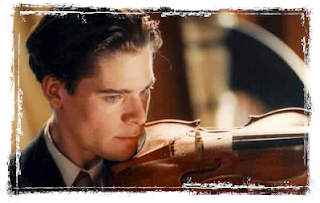


Costanza is drinking a beer in a Prague pub, a summer night in 1968, when a violinist enters and starts playing a "canone inverso" for her. It is not by chance... he is looking for her and she remembers that music. That violin, the music and the man have a story that might concern her. It is the love story between Jeno Varga - a poor jewish boy living in Prague before and during WWII - and the music, between Jeno Varga and Sophie Levi. It is also the story of the deep friendship between David and Jeno . Music and Love the most powerful bonds that could resist the passing of time. It is a beautiful film with brilliant actors, a great script and Ennio Moricone’s music. I've found  this clip on Ututbe. It is in English but it contains major spoilers, so if you want to look for this movie and watch it entirely, it is better to skip it. If,  instead, you want to see it, get ready, it is the moment when Costanza understands who the violinist is … who she is … where she comes from.


NEVER FORGET THAT THIS HAS HAPPENED



08/12/2009

THE HEART OF ME - DVD (2003) - MY REVIEW & MY SCREENCAPS


"And throughout all eternity, I forgive you and you forgive me." (W. Blake)

This line by William Blake is the leitmotiv of the movie I saw last night, THE HEART OF ME.
This is one of the latest acquisitions to my DVD collection. I didn't know anything about this movie when I decided to get it, except that it starred a triad of very good actors, HELENA BONHAM CARTER (Dinah) , OLIVIA WILLIAMS (Madeleine) and PAUL BETTANY (Rickie) and that it was set in the years before/after WWII.
I'm not disappointed  with - nor enthusiastic of - my choice. The film  is quite well done and it offers the cast of talented actors occasions for tears, anger, deception, passion  and so much sufference resulting in  many moments of surprisingly strong and affecting acting. The story is terribly tragic, terribly romantic, terribly unfair. Yes, as unfair as life can very often be.


Madeleine & Dinah in 1934

THE PLOT

England 1934. After the death of her father, Madeleine, a prim and proper - a bit repressed - well off housewife, invites her free-spirited sister, Dinah, to stay with her and her husband Rickie in her elegant London home. The couple has a kid, Anthony. Madeleine has always been secretly jealous and resentful of Dinah, an extravagant passionate young woman, who is the despair of their conservative mother, Mrs. Burkett. Madeleine makes any effort in her power to get Dinah engaged to a presentable man. Dinah, at last, gives in and  announces her engagement at a family dinner, but later that night Rickie, who has long harbored an attraction for her, tells her to put an end to the betrothal.
Rickie and Dinah fall in love and they become lovers. Rickie helps Dinah to settle in an apartment that becomes their love's nest, but they leave his marriage intact. Things get complicated when Dinah gets pregnant. ...


From a rapid look at the caps above you can get the terrible sufference the three protagonists experience. It is such a depressing story. Full of love and passion doomed to tragedy. It was impossible for me to take side for one or the other of the sisters. The moments of joy of one of them involved the deep sufference of the other. Madeleine and Dinah, so different, so loyal to their love. But terribly unlucky, they  loved  the same man. Instead he... he loves just one. He  choses one , not his wife, then he is tricked, deceived, manipulated and... will never recover from his broken heart ... Some signs of forgiveness and hope in the end...


Dinah and Madeleine in 1946

WATCH THE TRAILER


13/07/2009

THROUGH THE CENTURIES : The Second World War in my childhood memories and in a beautiful movie


Tonight I'm going to start my Period Drama Challenge. It has been proposed by Alex, Ana T. and Ana O. in their charming blog: LIGHTS, CAMERA ...HISTORY! I've subscribed for two categories:

1.THROUGH THE CENTURIES (4 items )

2. VICTORIAN MIST (4 items).

On the whole, I'll have to review 8 costume movies or dramas I haven't seen yet in a year's time. I want to work on stuff I haven't seen nor reviewed yet, so that it can be a REALchallenge. I 've decided to begin with the first category and I'm going to post about movies telling a story set in the 20th, 19th, 18th and 17th centuries as in a journey back in time . Some days ago I was reading a post in Marianna's blog, one of my blogmates, and she was writing about a book she read and a film adaptation she saw . Suddenly I remembered I owned that DVD but I had never seen it. It had been one of my online bargains, paid half -price: CHARLOTTE GRAY (2001) starring Cate Blanchett, Rupert Penry-Jones, Michael Gambon and Billy Crudup. Director Gillian Armstrong. Based on the novel by Sebastian Faulks ( the finale of the book is quite different, though).

CHILDHOOD MEMORIES

My interest in the Second World War time comes from my childhood experiences. Mind, I’m not that old! I'd better to explain ...

Falling asleep hearing the nightmarish sound of the terrifying booted march of German Nazi soldiers inside your pillow is not plausible if you are an 8/9- year-old little girl living in the 70s. But that happened to me almost every night. No princes nor princesses, no elves nor fairies, neither wizards, in my grandfather’s evening tales to us ; only real life, HIS real life. Well, it was me who asked him to tell me and my sister about his exciting adventures during the war and he willingly accepted. It was this way that my fascination for that period started…I learnt about his experiences in Africa where his younger brother died, his being caught and brought to India by the English, his return to Italy where he found his first son (my uncle) who feared him since he didn’t know him ( the poor little boy was only some months when hisfather had left), the Nazi occupation after the Armistice, the bombing of his native town by the American allies who wanted to force the Germans to leave, his attempts to protect his family ( now he also had two daughters, my mother and my aunt). Lessons of life, lessons of History I’ll never forget. So…whenever I see a movie set in that time I think of HIM, my first History teacher, my dear grandfather - who brouhgt me up with my grandmother since my parents worked 15 hours a day – of HIM who loved me dearly and now watches me from up there. It happened with this movie too. With “Charlotte Gray”.

THE STORY

In 1942, a young Scots woman, Charlotte Gray, travels to London to take a job. On the train she talks to a man sharing her compartment, and he - who works for one of the British secret service agencies at the time - gives her his card. Despite the war, social life in London is in full swing and the attractive, intelligent girl soon meets up with an airman, Peter Gregory. The temporary nature of life at the time is symbolised in their quickly lived relationship: she loses her virginity and also her heart to him. The intensity of the romance is heightened when Gregory is sent on a mission over France and news comes back to Charlotte that he didn't return and listed as missing in action.

Charlotte spent much of her childhood in France and speaks the language fluently - a talent that the secret service wishes to exploit in its effort to support the French Resistance. Charlotte decides to throw in her job and joins a Special Operations Executive (SOE)* training course. Once it has schooled her in methods of interrogation, dyed her hair a mousy brown and replaced her fillings, Charlotte is parachuted into France to complete a specified mission. But instead of doing her job and heading home, she sets out to find Gregory's whereabouts.
She assists at a parachute drop but then settles down as housekeeper to an ageing man, father of her main resistance contact, Julian. Over time she comes to understand him in a way she never had understood her own father. Both the old man and Charlotte's father fought in the First World War and bear lasting physical and psychological scars. She also helps to conceal two Jewish children, André and Jacob, after their parents are arrested and deported, and as 1942 progresses we learn about the steadily growing oppression of the Jews in France with complicity by the Vichy French government. Julian’s father is interviewed about his Jewish ancestry, and when he stays silent, his son denounces him in order to save the two little boys hidden in their house. The old man is then packed off with the two jewish boys André and Jacob to the prison camp/transfer station in Drancy where Charlotte manages to get them a moving message: a reassuring fake letter for the two boys saying that their parents are alive and will go and rescue them, they had to behave properly and eat well, meanwhile. The children and the old man, instead, will be shuttled like cattle to their deaths at the Auschwitz concentration camp in Poland. Although Charlotte has faith that Peter Gregory is still alive, she cannot trace him , so in 1943 goes back to London. Here, she will soon discover her hope has come true: Peter is alive. But their meeting is strange, she can’t feel for him any longer . Her life in France has changed her and she can’t go back to what she was like before. She has left her heart in France and must go back there: Julian is waiting for her, he has always loved her.


PART OF THIS REVIEW HAS ALSO BEEN POSTED ON
LIGHTS, CAMERA, ... HISTORY!