It is impossible not to think of war these days. Press and TV news keep our minds and hearts in constant worry. Though I usually avoid writing or
discussing breaking news or politics here on my blog , today I’m going to tell you about this beautiful movie I have just seen, with all my heart to the news coming from the several open fighting fronts.
War is no game. War
leaves a mark. Eric Lomax , like many other surviving soldiers, lived haunted by his war memories all his life
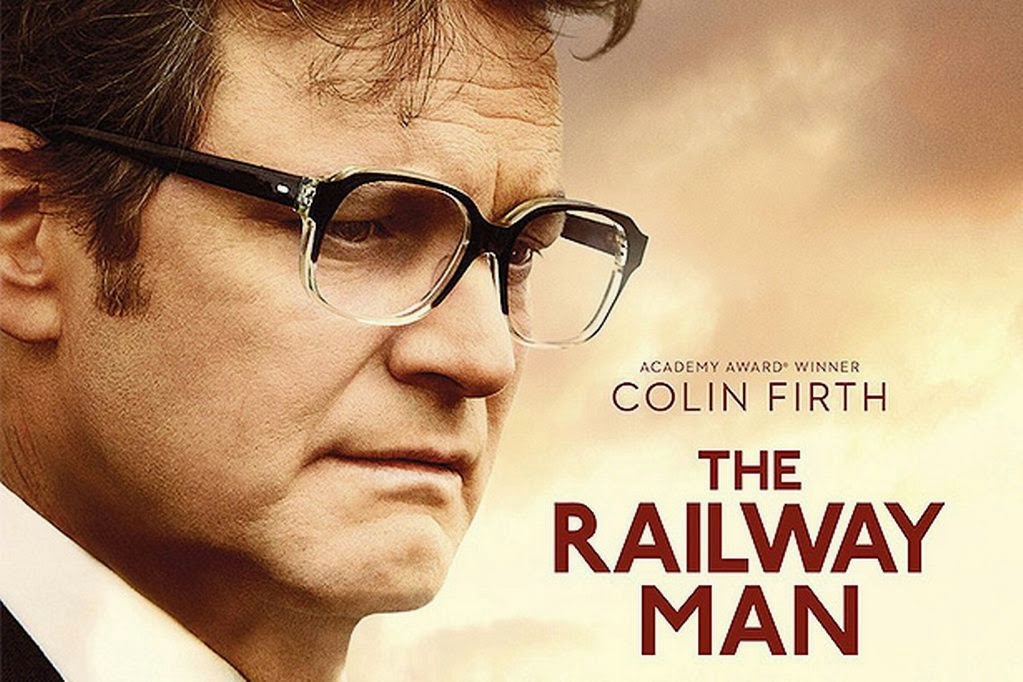
through, as if war never actually ended in his mind and his heart. The Railway Man,
based on Lomax’s autobiography, will
come out in September 2014 here in Italy
as “Le due vie del destino”, but it opened theatrically on New Year’s Day in
the UK and , in the US, in April 2014. It is already available on DVD at amazon.co.uk
and, from August 12, it will
be at amazon.com
too.
"From his mother he drew the life warmth, the strength to produce; Miriam urged this warmth into intensity like a white light" (from chapt. 7)
I've finally watched this two-part series I have had on my TBW list for a while. To remind me of it, my watching "A Dangerous Method" in Rome last week. It is 2003 ITV adaptation of D.H. Lawrence's Sons and Lovers, an autobiographical novel based on his own early life, in particular his close relationship with his middle-class mother in comparison with his father, a mineworker. At the time of writing the book, Lawrence was probably reading/studying Freud though he always denied the influence. Indeed the book is often regarded as a meditation on the workings of the Oedipus complex, but it is in its own right an accomplished novel which goes beyond its specific biographical and theoretical references. Lawrence himself defined it as a tragedy, "the tragedy of thousands of young men in England".
As some of you might remember, I'm fond of WWII movies as well as of films set in older times. I had this 2009 DVD, THE GLORIOUS '39, there waiting in my TBW list for quite a while. This is not "Schindler's List" nor "La Vita è Bella" nor "Agnes Gray" either. But it was quite an interesting discovery.
It seems this film bears all the traditional hallmarks of Stephen Poliakoff obsessions: the evocative power of the past, the magic of memory, the mystical bonds of extended family connections, the hidden energies of secrets kept buried for too long, and the shattering consequences of the revelation of truth which has been suppressed. It is weird but original and well acted and, of course, with stunning locations, picturesque castles, hunting grounds, elegant gatherings.
Warning: Major spoilers, if you haven't seen series 9 yet
(you'll find a link to the video at the end of the post)
I'm so happy. My Spooks 9 Boxset has just arrived. It's a gorgeous box with 3 DVDs. On the back of the box it says:
BAFTA award-winning British television spy drama Spooks is back for another knuckle-clenching series which leaves Section D questioning how much a person must sacrifice to be a spy. The ninth series of the critically acclaimed Spooks is filled with dramatic revelations and a host of new characters: Sophia Myles (Underworld, Doctor Who), Max Brown (Mistresses, The Tudors), Ian Glen (The blue Room, Lara Croft: Tomb Raider) , Simon Russel Beale (Much Ado About Nothing, Uncle Vanya) and Laila Rouass (Primeval, Footballers' Wives).
Friendships will be tested and depth of deceit will lead to an unprecedented game of cat and mouseasthe characters they play and the impact they have on the team dynamic will have viewers enthralled.
I've already seen all the episodes and some of them more than once. So, where did I start watching my new DVDs from? Disc 3 and its bonus interviews, of course! They are so interesting! I've always liked the behind the scenes stuff, but you know the reason why I am so interested in these extras. I can't deny it: Richard Armitage.
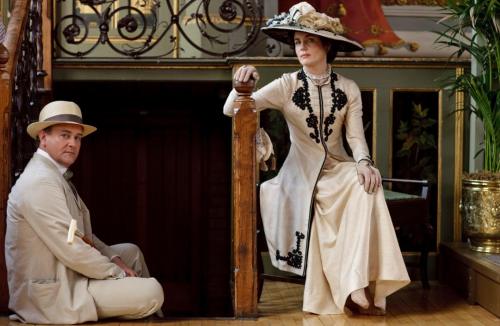
I've heard few dismissing comments like "it is not ITV Upstairs, Downstairs nor Gosford Park and neither an Austen adaptation" (The last claim puzzled me a bit) . I've read that it is full of clichés and nothing original. But now that I HAVE SEEN IT, though partly agreeing with the previous statements, may I say that this is a really pleasurable drama, the wittiest and most intriguing I've recently watched? It made me so eager to see what happened next, episode after episode. I very much enjoyed watching the 7 episodes, it was some time since something I saw made me so enthusiastic. DOWNTON ABBEY is a must see for period drama lovers. It was broadcast on British ITV 1 in October/November 2010, it is being aired on US PBS Masterpiece Classic at the moment, but it can also be bought as a DVD ( HERE or HERE ). Second series coming in 2011. I can't wait! And, again, if you love period drama, you can't miss it!
The story begins in April 1912 when the heir to the title of Earl of Grantham, long time inhabitants of Downton Abbey, perishes on the 'Titanic'. The benevolent current Earl (Hugh Bonneville) has three daughters, Mary, Edith and Sybil, but the property is entailed and can be inherited only by a male heir. This P&P-like beginning shows the Crawley family at risk of losing their richness and their privileged rank. (If you want to understand properly the complex legal question on which the fate of the protagonists depend, read this absolutely interesting and enlightening post at Austenprose :Downton Abbey Entailed? Understanding the Complicated Legal Issues in the new Masterpiece Classic Series).
The Crawleys of Downton are going to lose not only their grand manor house but the Countess of Grantham's (Elizabeth MacGovern) huge patrimony. She is, in fact , a very wealthy American heiress the Earl had married for convenience: her money had been indispensable to manage his wide estate. However, now, they love and respect each other deeply, though their married life, as in many other cases, had started more as a business agreement. This is what Mary, their eldest daughter, was supposed to do, too. A marriage of convenience with the younger heir of Downton, now drowned with his father in the Titanic tragedy. What now?
There is only one proper solution: to marry their daughters to someone rich, especially, her, Mary. And who's better candidate than the new heir of Downton Abbey, Matthew Crawley (Dan Stevens) , a distant cousin and a lawyer? Distant he is, in every sense, from the Crawleys living at Downton Abbey. He has always worked, he's sensitive but very practical-minded, intelligent and stubbornly modern, he refuses the aristocracy's stiff old manners, their formality, and hates the idea of becoming one of them, one of the privileged. He is a self-made man.
However, he and his mother move in from Manchester and starts being interested in the estate and its inhabitants. Matthew goes on with his job and starts a friendly relationship with Lord Grantham. His mother volunteers in the local hospital and competes with Lady Violet (Maggie Smith), the Earl's mother, on many an occasion. Matthew falls in love with Mary at first sight, but she doesn't like him at all. Above all , he represents what she doesn't want, a marriage of convenience, what she doesn't accept, to sacrifice her freedom for the future of her family. So, you see, again something very P&P-like : first impressions!
The batallion of servants living downstairs and running the house, cleaning the place, taking care of the family offer other gripping plots which are interwoven with those involving the ones living upstairs. I loved the characters downstairs and their stories. Mr Bates's (Brendan Coyle) mysterious past and his newly-born, still timid, relationship with kind Anna (Joanne Froggatt); Mr Carson's (Jim Carter) generous and authoritative managing the staff and connecting the upstairs to the downstairs world; Mrs Hughes (Phyllis Logan) discreet and efficient presence as well as her unexpected past romance; the envious, ambitious and wicked pair , Miss O'Brien (Siobhan Finneran ) and Thomas (Rob James-Collier), and their plots to hurt whom they don't like; then Mrs Patmore's (Leslie Nicol) , the cook, story , which is sad and funny at the same time;
Gwen 's dream (Rose Leslie) of improving her education who is looking for a new position as a secretary with the secret sympathy and help of one of the young ladies of the house, Sybil; William Mason (Thomas Howes), the second footman having a crush on Daisy (Sophie McShera),the scullery maid, who is instead in love with Thomas, the first footman, she has kind of idolized without realising his real nature; finally the chauffeur,Tom Branson (Allen Leech) who introduces Sybil Crawley, the Earl's younger daughter's, to his own socialist ideals .
All these incredible stories remain open to new developments. The series ends with a cliffhanger: England is at war with Germany, the First World War has broken out.
The location. Highclere Castle , in Hampshire, is a stunningly majestic country residence in the Elizabethan style. (Read about it and visit the official site) It has been already used as a location for films and TV series: the saloon appeared in the film The Four Feathers starring Heath Ledger; the exterior appeared as Lord Graves's house in the film King Ralph; it wasTotleigh Towers, in the TV version of Jeeves and Wooster. Shots from both the interior and exterior are used as the imposing Mistlethwaite Manor in the 1987 version of The Secret Garden.
If you live in the US and missed the first episode, PBS will be making each episode available for a few weeks after its initial airing. Downton Abbey is available for online viewing from January 10 – February 22, 2011.
Do you like re-watching old period dramas for the umpteenth time? Do you like finding links and similarities between stuff you read or watch? I'm almost a maniac. I'm always there noticing analogies, similarities, links and connections while watching or reading. I did the same this last weekend re-watching P&P 1995 and seeing for the first time "12 Men of Christmas". It hadn't been planned as a comparative watching but it came out like that.
This is the story of the most notorious double agents in the history of spying.
Four very British traitors (from Cambridge Spies DVD)
"Betrayal is a cancer. Let it eat your soul ...". I'm quoting Sir Harry Pearce from Spooks 9. But it doesn't seem like that at all watching this gripping drama.The glamorous four are rather romanticised and manageto pass through awful historical tragedies with a certain light touch.
I found it among my pile of TBW stuff. It is a BBC 4-part series starring Tom Hollander, (Guy Burgess) Toby Stephens (Harold Kim Philby) , Rupert Penry-Jones (Donald Maclean) and Samuel West (Anthony Blunt) . It conjugates spy and period drama. CAMBRIDGE SPIES was broadcast on BB2 in 2003 and, if you like me missed it, it is available on DVD.
For someone loving period drama, it is a happy reunion of familiar faces. Brilliant cast indeed.
The truth behind fiction
Maclean, Burgess, Philby and Blunt were British members of a KGB spy ring that penetrated the intelligence system of the UK and passed vital information to the Soviets during World War Two and the early stages of the Cold War.
The members of the ring were Donald Maclean (1913 - 1983) Guy Burgess (1911 - 1963), Harold 'Kim' Philby (1912 - 1988) and Anthony Blunt (1907 - 1983). Several other people have been suggested as belonging to the ring, including John Cairncross. Blunt became a communist in the early 1930s and was recruited by the NKVD (later KGB), the Soviet security agency. While teaching at Cambridge University, Blunt was influential in recruiting the other three, who were all students there.
Burgess became a journalist after he left university, but on the outbreak of war joined MI6. Maclean was in the Foreign Office during the same period. In 1951, tipped off by Philby that they were under suspicion, Burgess and Maclean defected to the Soviet Union, where they spent the rest of their lives.
Philby was also a journalist but joined SIS (also known as MI6) in 1940. Just before the war ended, he was appointed head of SIS's anti-Soviet section. Thus the man charged with running operations against the Soviets was a KGB agent. He later became chief British intelligence officer in the United States. After Burgess and Maclean fled to the Soviet Union, Philby came under suspicion and was forced to resign. In 1963, he defected to the Soviet Union, and died there. Blunt worked for MI5 during the war. After the war he had a distinguished career as an art historian. He was director of the Courtauld Institute and Surveyor of the Queen's Pictures. He was knighted in 1956. In 1963, the British government discovered he was a spy but offered him immunity in return for information. In 1979, the story got out and Blunt was stripped of his knighthood.
Good quality TV
It is good TV drama though I've read reviews complaining for many historical inaccuracies. Being not that informed about the real story of these glamorous double agents, I just tried to enjoy the interesting, involving plot Peter Moffat created in his screenplay. I loved the 4 protagonists, I admired the fact that the characters are portrayed accurately and convincingly. Having just seen the last of the four parts, I must admit that for entertainment value it is top notch. If you watch it with an open mind, as the game of four masterminds who underplayed the archaic MI6 for their principles, you'll enjoy 4 hours of great TV.
It's actually rare to find a costume drama set in the 17th century. The only good one I can remember, which I also reviewed on this blog, is Gunpowder, Treason and Plot dealing with the Gunpowder Plot (1605) against James I .The Devil's Whore, which I watched at the weekend, is an extremely-engaging and well-acted 4-part drama about the period 1642-1660 covering the English Civil War and the subsequent execution of King Charles I and his replacement with England's only republican government. Don't expect to learn or understand more about that complicated historical period but for once drama faced not an easy task and chose differently for its time setting.
The Devil’s Whore, is full of wild storms, furious winds and camera angles so eccentric they make it look like chaos has come to Earth. its talented director, Marc Munden , tries to conjure a sense of impending apocalypse. It is s a tale set in the English Civil War about a fictional woman, Angelica Fanshawe, and how her life intersects with the real events and key figures of the time, including Charles I ( the beheaded Stuart King) and Oliver Cromwell.
To many who witnessed this period in British history, apocalyptic was just how it felt. In the 1640s fighting engulfed the country and the rule of law collapsed: it was the end of the world as people knew it.
The speed with which the plot unfurled is, at times, bewildering. I was completely taken away by the quick pace and gripping narration of the events. Kudos to Peter Flannery, the scriptwriter, for making this period of history really interesting. This difficult period, as I wrote in the opening, has never really been covered in movies or TV.
Peter Capaldiis great as a doomed king, Michael Fassbender is intense and stunning as Rainsborough, Dominic West magnetic as Oliver Cromwell, but my favourites are John Simm and Andrea Riseborough. Both act intensely and make me want to keep watching and get quickly to their next meeting. The chemistry, sparring and respect between Sexby and Angelica is fascinating! Almost perfect...
The Devil's Whore was broadcast on Channel 4 in 2008. The initial critical reception was good, though there has been some criticism of the omission of some figures and events (such as John Pym, the Earl of Bedford, Sir Thomas Fairfax, Sir Denzil Holles, 1st Baron Holles, Edward Hyde, 1st Earl of Clarendon, Pride's Purge, Colonel Sir John Hutchinson and the Bishops' Wars) and the fictionalisation of others (such as the suggestion that Cromwell orchestrated Rainsborough's death, of Rainsborough not Sexby being a close friend of Cromwell's, and Sexby's assassination attempt on Cromwell).
What if Sherlock Holmes lived in present-day London and had the chance to support his brilliant, sharp deductive mind with technology and the Net? You can find the answer to that watching the 3 episodes of the new Sherlock BBC ONE broadcast not long ago, Masterpiece PBS has just shown and which is already available on DVD.
Sherlock Holmes is played by Benedict Cumberbatch, John Watson by Martin Freeman ( who is going to be Bilbo Baggins in The Hobbit movies and was in Love Actually) , Mrs Hudson by Una Stubbs (Eastenders), Inspector Lestrade by Rupert Graves (Maurice, The Tenant of Wildfell Hall) , Molly Hooper by Louise Brealey (Casualty, Bleak House), Sargeant Sally Donovan by Vinette Robinson (Between the Sheets) and Sarah, Watson's love interest, by Zoe Telford (The Golden Hour). Lots of familiar faces, aren't there?
Episode 1 - A Study in pink
Episode 2 -The Blind Banker
Episode 3 - The Great Game
Martin Freeman is John Watson
The world's favourite detective has emerged from the fog. With sparkling scripts and unforgettable performances from the two leads, this is Sherlock for a new generation.
Sherlock has a unique analytical mind, earning his living and staving off boredom by solving crimes. The weirder and more baffling the better ...
Across three thrilling, scary, action-packed and hugely entertaining episodes, Sherlock and John navigate a maze of cryptic clues and lethal killers to get at the truth.
Sherlock Holmes was always a modern man – it's the world that got old.
Now he's back as he should be – edgy, contemporary, difficult – and dangerous!
John Watson – Doctor, soldier, war hero. Fresh from military service in Afghanistan, a chance encounter brings him into the world of Sherlock Holmes – loner, detective, genius. The two men couldn't be more different, but Sherlock's inspired leaps of intellect coupled with John's pragmatism soon forge an unbreakable alliance.
Mind you ... it is clear there will be a series 2! The third episode ends in a dramatic cliffhanger ...they can't leave us like that! We want to know what happens between Moriarty and Sherlock! That gun will stay aimed and still until Sherlock 0201!
Have you seen this series? Did you like it? I think this is actually a brilliant intelligent TV production. Waiting for more!
I needed to forget a hardworking Sunday (yes,Sunday!) and I put my Bridget Jones DVD set on : Bridget Jones's Diary and Bridget Jones - The Edge of Reason. I hadn't re-watched either of them since I had seen them long ago at the cinema. My purpose was pure escapism,of course, but also to discover how much Austen there is in them.
Like every Sunday, yesterday I had my huge quantity of ironing and period drama watching! You can understand how huge my laundry pile was trying to sum the lengths of the films/series I watched! I'm sorry, no prize if you guess. LOL!
THE MILL ON THE FLOSS (BBC 1997)
"Anger and jealousy can no more bear to lose sight of their objects than love..."
George Eliot's Middlemarch was reasonably adapted in a six-hour mini-series (I saw it couple of years ago and it's time to re-watch it!) The Mill on the Floss, between 400 and 500 pages, gets crammed into less than two hours (about 116 minutes). This is the main complain I have to do against this beautiful adaptation of a Victorian classic. I bought this DVD long ago but never even unwrapped it from its transparent film. So it was still brand new when I decided to put it in the player and watch it yesterday. The story covers about eight years, it's actually three mini-novels: a satire of provincial small-mindedness focusing on mill owner Edward Tulliver and his children Tom and Maggie; a "Romeo&Juliet" story in which Maggie falls in love with Philip, the son of her father's greatest enemy and incurs the wrath of her beloved brother ,Tom; and a romance in which Maggie is courted by sensitive hunchback Philip (her Romeo) as well as conceited but very attractive Stephen (her cousin Elizabeth and best friend's fiancé) while still trying to get her mind off . . . Tom. Yes, her brother , the most important man in her life. She can't stand the idea of breaking the secial bond she has with him. The book's central metaphor, the river Floss is also the prevailing symbolical imagery in the photography: a flood of passion carries Maggie and Stephen away in a rowboat before a concluding deluge of Biblical proportions turns the river into a real flood.
This concised adaptation byHugh Stoddart leaves apart Eliot's occasional moralizing but loses the complexity of her characterizations. As always in BBC period drama, the settings are awesome, as perfect as the costumes ; the score is good and quite romantic and the acting is contained and cultivated.
Emily Watson as the protagonist is worth watching as she captures Maggie's perplexing combination of self-sacrifice and self-indulgence. Ifan Meredith's Tom quite resembles the "lad with light-brown hair, cheeks of cream and roses, full lips, indeterminate nose and eyebrows," but the smoldering resentment in his face suggests a loveless childhood as well as a complex love/hate relationship with Maggie. Is the girl the victim of Tom's domineering? Or is she incapable of marrying Philip or Stephen because she loves her brother more ? Tom in the whole story never looks at another woman. Well ... just my hypothesis. George Eliot in the end makes Maggie the victim of a hypocritical patriarchal society as she herself was.
Drama, romance and tragedy in a story of one woman's struggle for freedom and love.
FINGERSMITH (BBC 2005)
After watching Tipping the Velvet (see my review here) not long ago, I was not sure I actually wanted to see this. What still stirred my curiosity was to see some good actors I appreciated in other period pieces in their roles here. For instance, Rupert Evans (Frederick in North & South or Frank Churchill in Emma 2009), Sally Hawkins ( Anne Elliot in Persuasion 2007, Zena Blake in Tipping the Velvet 2002), Imelda Staunton ( Viola's nurse in Shakespeare in Love, Charlotte Jennings Parker in Sense & Sensibility, Octavia Pole in Cranford) , Elaine Cassidy (Lucy Honeychurch in A Room with a View 2007) . Both Fingersmith and Tipping the Velvet are novels by Sarah Waters adapted by BBC, set in the Victorian Age. I have read neither of the books so I can't tell you how faithful to the original they are.
I wasn't disappointed though. I find this 2-part mini-series (181 min.) Fingersmith much more gripping and original than Tipping the Velvet. Since the first moment you are brought back to the mean streets of Dickensian London (There are plenty of nods to Dickens)and find yourself deeply involved in a thrilling drama, packed with thieving and treachery, romance and betrayal.
Set in 19th-century London, Fingersmith - Victorian slang for pickpocket - tells the story of a young woman who becomes embroiled in an elaborate deception and discovers that nothing is quite what it seems.
The story begins when charming con-man Richard "Gentleman" Rivers (Rupert Evans) embarks upon the most ambitious scam of his life: to defraud wealthy young heiress Maud Lilly ( Elaine Cassidy) by seducing her into eloping with him.
To achieve his aim, Rivers enlists the help of Sue Trinder (Sally Hawkins).
Brought up by Mrs Sucksby (Imelda Staunton) in a Fagin-like den of thieves, orphan Sue is a fingersmith with a heart of gold – and the promise of a share in Maud's fortune is enough to convince her to join Rivers in his extravagant plot. A particular delight is the villainous "Gentleman".Why am I always so attracted by villains? I can't answer that but I know I'm in good company!
Well, Rupert Evan's "Gentleman" Rivers hasdevilish charm, wit and a sexy Mr Churchill-gone-very-bad attitude I couldn't resist, differently from the female characters in the story. But there's a reason why...
Can I be honest? Since I'm not a prude I didn't find anything offensive in this story but I wonder -since also this novel by Sarah Waters like her previous Tipping th Velvet deals with lesbian love and is set in the Victorian Era - what the author's aim was... did she want to convince Queen Victoria herself that lesbians existed? Too late it seems! (Joking of course on the fact that Queen Victoria, while accepting homosexuality in men, is said not to have been able to believe lesbians existed!)
"Marriage is the tomb of love" . This is one of Casanova's most widely-known quotes.
YES! My attraction to libertines and rakes couldn’t but lead into Giacomo Casanova ’s arms. How could any woman resist his seductive charm? Usually Casanova’s name is confused with that of Don Juan but while the latter is a literary, fictional rake, the first one is a real man, born in Venice in 1725 and died in Bohemia in 1798. He was so famous as a womanizer that his name remains synonymous with the art of seduction.
His memoirs are considered the swan song of the 18th century libertine. In Bohemia he died surrounded not by lovers but by books. “He did not go down shouting his disdain for morality, like Don Giovanni he went with a wry smile and a knowing joke as the curtain fell.” ( Ian Kelly, “Casanova: Actor, Spy, Lover, Priest”)
The 3-part BBC version of Casanova I've been watching is extremely delightful. The cast is outstanding, especially David Tennant as younger Casanova , Peter O'Toole as the older Casanova (who is narrating the story to a young woman years later). The sets and costumes are colorful and romantic and the script is generally witty and funny. David Tennant saying : "You love your wife, I love your wife, we're on the same side!" is just memorably brilliant. Most of the plot is focused on Casanova’s romantic relationship with his true love, Henriette (Laura Frazer) , who choses a convenient marriage to Grimani ( Rupert Penry-Jones )and condemns herself and his lover, Casanova, to a life of longing. She will always watch on Giacomo and will come each time he will be in need of help. Henriette is a beautiful character, as are Rocco (Shaun Parkes , his loyal friend and servant) and Bellino (Nina Sosanya , a castrato? a man! No, Casanova's almost - wife).
This mini – series is funny, irreverent, very fast moving and it keeps you watching. David Tennant portrays Casanova as a cheeky 21st century rake and is immediately likable. At first sight.
Peter O'Toole, as the older Casanova explaining his life story to a girl of formerly high family who has fallen on hard times and is acting as his maidservant, performs his part with all the best elements of his enormous experience.
Giacomo Casanova died in 1798. A year earlier, Napoleon had brought an end to the long debauch of the Venetian republic and its even longer decline. The whole 18th century culture would soon die, too, fading away and leaving space to the Romantic ideals. Europe was about to become what playful, joyful Casanova could never manage to be: serious.
In my attempt to catch up with such an incredibly rich and active career as Colin Firth’s, I ‘ve been recently very lucky and managed to watch two wonderful films in one day: Girl with a Pearl Earring (2003) and A Single Man (2009). I really can’t tell you which one I liked more because I did liked both very much though in different ways.
In “Girl with a Pearl Earring” I loved the costume movie and the poetry of colours. Not as much the story, actually. This film, adapted from a work of fiction by Tracy Chevalier, tells about the events surrounding the creation of the painting "Girl With A Pearl Earring" by 17th century Dutch master Johannes Vermeer. Little is known about the girl in the painting, it is speculated that she was a maid who lived in the house of the painter along with his family and other servants, though there is no historical evidence .
The film , set in 1665, is not only about art and the creation of a masterpiece but it is also about exploitation and how a young woman attempts to resist a system designed to make her a vulnerable victim.This was the aspect I most appreciated in the plot . Griet is a Protestant among Catholics, a generous woman in a world of selfish human beings, a poor honest girl in a household full of pretences . But she is strong-willed, only apparently fragile. And she has a gift, she understands art and she has a special sensitivity for colours, this is why Vermeer, the master, choses her. Not for his lust but for his art. Anyhow, Griet feels trapped, not free, like the maid servant ( a dummy) Vermeer was painting among a chair, a table, a window and a wall… Griet dares move the chair from the place the painter had put it. When he asks her why she answers directly and simply , “she was trapped”. In Vermeer’s paintings his maids are quite passive, Griet does not accept her destiny passively.
Griet is despised by Johannes Vermeer’s permanently pregnant wife and by her wicked children. Vermeer as a painter is patronized by the lecherous merchant Van Ruijven who wants Griet in his house and even tries to rape her. But she resists.
She has got a boyfriend, Pieter, the butcher’s son who warns her:
Pieter: Don't get caught up in his world.
Griet: I may only be a maid, but I would NEVER give in to Master Van Ruijven!
Pieter: I wasn't talking about Van Ruijven...
She’s attracted by her master, of course, but even more by the magic he can do with colours and light. Pieter fears he can lose Griet for that.
Griet and Vermeer never go beyond the limits of an emotional relationship. No sexual involvement. Though the scene of master Vermeer piercing her left ear is highly symbolical and extremely sensual. Just as the attraction and the tension between them is palpable while they mix the coloured paints together. Their relationship becomes closer while Vermeer paints Griet for Van Ruijven . Catharina's growing jealousy of Griet becomes more and more apparent, and she finally discovers the theft of her earrings, accusing her own mother of complicity (she had given Griet her dauther's earrings) and ordering Vermeer to show her the painting he and Griet have been working on. It is obscene to her and Griet must leave the house.
Cast: Colin Firth as Johannes Vermeer; Scarlett Johansson as Griet; Tom Wilkinson as Piet Van Ruijven; Judy Parfitt as Maria Thins ;Cillian Murphy as Pieter; Essie Davis as Catharina Vermeer; Anna Popplewell as Maertge
French cinematographer Eduardo Serra and his Dutch collaborators, the production designer Ben van Os and the costume designer Dien van Straalen, have given the movie extraordinary beauty. The landscapes are enchanting. The stern, black-dressed mother-in-law seems just come out of a Rembrandt. The interiors and exteriors of Delft resemble paintings by Vermeer, Pieter de Hooch and their contemporaries brought to life. That beauty will stay always with me. More than the story itself.
• Most of the events in the novel's epilogue, such as Griet's marriage to Pieter and their two children, Jan and Frans, are not shown in the film.
• In the novel, there is a subplot involving Griet's younger sister, who eventually dies from the plague.
• In the novel, Antonie van Leeuwenhoek warns Griet not to get too close to Vermeer, but he is absent from the film and his lines are given to Pieter.
• In the novel, Griet and Tanneke have a difficult relationship, but in the movie, they seem to get along. This is shown by Tanneke's teasing Griet about Pieter and her willingness to chat and gossip.
• In the novel, Griet pierces her left and right earlobe herself. In the film, Vermeer pierces the left one for her, while she does not have to pierce her right lobe
A Single Manpremiered on September 11, 2009 at the 66th Venice International Film Festival where Colin Firth was awarded the Coppa Volpi as Best Actor. He also won at British BAFTA as Best Actor for this movie. He well deserved all the positive responses to his role as George Falconer, because the entire film is emotionally on his shoulders and he gave us a gripping and stunning performance.
The film is based on the novel of the same name by Christopher Isherwood and was directed by fashion designer Tom Ford, who, as a first-time director, had to finance it himself. Colin Firth stars as the protagonist George Falconer, a gay British university professor living in Southern California in 1962, a month after the Cuban missile crisis. The film places emphasis on the culture of the 1960s but most of the lines and the scenes go beyond space and time. They are universal and eternal. I so often wanted to stop the movie and write down what I had just heard. But I didn’t do it. The narration, slow, deep, inolving couldn’t be stopped. I didn’t want to stop it. I ‘ll rewatch it. That’s for sure.
Throughout the single day depicted in the film, and narrated from his point of view, George Falconer dwells on his past, shown in flashbacks, and his seemingly empty future, as he prepares for his planned suicide that evening. He feels lonely and depressed: he can’t forget his lover, who died in a care accident 8 months before. He buys bullets for his revolver, empties his safety deposit box in the bank, prepares letters for some friends, and one with some money for his cleaning woman, and arranges his life insurance policy, other important things such as keys, and the clothes he wants to be dressed in by the undertaker neatly in sight. Everyday things and encounters become special for him, realizing that for each it is the last time, and he is extra nice to people, as he is secretly saying goodbye.
I don’t want to give away much more. I don’t want to spoil your personal watching of this movie. But of course I can’t avoid saying that George is gay and the lover whose loss he can’t overcome was Jim, an architect, who had lived with him for 16 years. However this film is nothing about sexuality and much, much more about love, faithfulness, friendship, loneliness, prejudices, hypocrisy, war and fear. The role of a lifetime for Colin Firth after so many brilliant performances .
Cast : Colin Firth as George Carlyle Falconer; Julianne Moore as Charlotte (Charley); Nicholas Hoult as Kenny Potter ; Matthew Goode as Jim; Jon Kortajarena as Carlos; Paulette Lamori as Alva; Ryan Simpkins as Jennifer Strunk; Ginnifer Goodwin as Mrs. Strunk; Teddy Sears as Mr. Strunk
I want to close this post with an answer Colin Firth gave in a long and interesting interview about this film about his character’s homosexuality:
Reporter: But being a closeted gay man in 1962 makes George more secretive, right?
Colin : Yeah, but people are secretive about their sexuality, generally, in one way or another anyway, unless they’re Italian. Sorry, that’s a dig at my [Italian] wife. Not everybody flaunts their sexuality, but I take your point. I think certainly in 1962, he’s a college professor, and [his homosexuality] might have made people more suspicious of him. In the ‘70s, when I was a teenage schoolboy, the idea that anybody might be gay also implied that they might be some sort of predator. Those are the kind of prejudices. I think we live with those less now in our society.
I really hope we do, Colin. But I’m not that sure, unfortunately. However, thanks for this beautiful, unforgettable movie and for an awesome performance.
Watch the trailer of the movie - Isn't the soundtrack great, too?




_-_The_Girl_With_The_Pearl_Earring_(1665).jpg)


