Showing posts with label Period Drama Challenge. Show all posts

14/12/2009

VICTORIAN MIST(ERIES) : SALLY LOCKHART


It's time to wrap up beautiful Period Drama Challenge.This is my last review, the 4th in the section Victorian Mist. The 8th task on the whole. Thanks to LIGHTS, CAMERA ... HISTORY for hosting it. It'll go on till July 2010.

THE SALLY LOCKHART MYSTERIES (DVD review)

Sally Lockhart's London, misty Victorian London, has a surplus of opium dens, mediums and boarding houses, it is a place where there were still enough shadows to conceal casual murder and where bodies could be buried beneath mud floors. It is in this world that Sally Lockhart hears of a priceless ruby , a precious stone that brings violence and death into hers and many other people's lives as well as  the memory of a murder in the cloud of opium smoke.


Sally Lockhart is a brave Victorian heroine created by writer, Philip Pullman. He wrote four novels in this series


The Ruby in the Smoke

The Shadow in the North

The Tiger in the Well

The Tin Princess


BBC has adapted the fist two ones so far, starring Billie Piper as Sally.

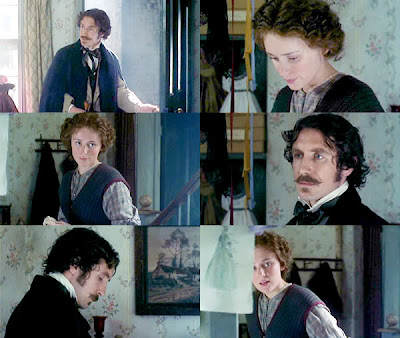
Episode 1. The Ruby In The Smoke opens in 1872 with young Sally Lockhart finding a message from her father, joint owner of the Lockhart & Selby shipping firm and who recently went down with all hands on the Lavinia in her sinking in the far east. The letter tells Sally to beware of the Seven Blessings, which means nothing to her but which is something of a dire warning for others as, when Sally asks the company's secretary about its meaning, he drops dead of fright before her very eyes. In the same office, Sally meets Jim Taylor (Matt Smith) and together they investigate why death seems to follow the Seven Blessings. The road to the truth takes in murder, the smuggling of opium and the mysterious Ruby of Agrapur. And all the while they are watched by the wicked Mrs Holland ( Julie Walters). Sally makes new friends who will become her new family, Frederick Garland ( J.J. Feild ) and his sister, who will support her in solving the mystery …

2. The Shadow in the North . Six years have passed . Jim and Frederick are running a detective agency and Sally hasn't just found herself a dog ( a big black frightening one)  but now runs a well-regarded financial consultancy.  The Shadow In The North is slightly the better of the two films  but only in its focusing more on the story than on the atmosphere. Briefly...
The story is set in 1878 when an old woman loses a large sum of money by investing in a British shipping firm. Twenty two year old Sally Lockhart, a financial adviser, sets out to investigate the cause of the sunken ship and learns about a wicked plan to release the Hopkinson Self-Regulator, also known as the Steam Gun. Pursuing this, she becomes tangled in the stories of a young magician, a jolly old medium and Lord Wytham, whose debt has forced him to marry off his daughter for money...

Two great  mystery stories set in  dark and misty Victorian London, perfect for the next cold December nights. Lots of familiar faces and very good actors. Good drama , BBC style.


26/11/2009

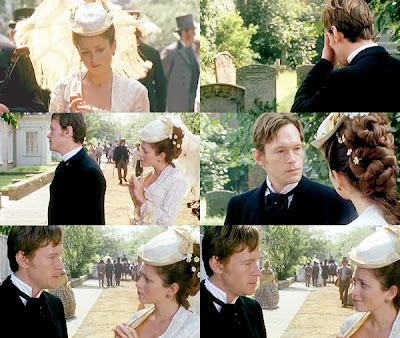
VICTORIAN MIST(ERY): THE MOONSTONE


Mystery stories are not my cup of tea but when it comes to classic fiction, well, it’s different. I love Conan Doyle’s Sherlock Holmes or Oscar Wilde’s Picture of Dorian Gray as well as Agatha Christies’s Poirot or Miss Marple.


I have always read about THE MOONSTONE as the first detective story in English Literature (or in literature in general?) but never actually read the novel. Due to my constant lack of free time and to the thickness of this book I decided ( I perfectly know it is not the same!) to buy the DVD, since I heard two of my favourite Brits where in it: GREG WISE and KEELEY HAWES. I wasn’t disappointed. Not at all . Though I found it rather unbelievable in more than one points. Mysteries are mysteries and often their explanation is not at all convincing… I usually prefer when they aren’t completely solved or unveiled; when you,  reader  or watcher, are asked to contribute your own hypothesis with your own fantasy.

Now… to the point.

This mini-series was aired in 1996 on BBC1 then also in the US for Masterpiece Classics in 1997.

The adaptation stars a remarkable cast of actors and is a faithful adaptation of Wilkie Collins' mystery (1868) in which the disappearance of a cursed diamond sets the background for an absorbing detective story. The Moonstone was originally serialized in Charles Dickens' magazine All the Year Round. The Moonstone and The Woman in White are considered Wilkie Collins' best novels. Besides creating many of the characteristics of detective novels, The Moonstone also represented Collins' social opinions by his treatment of the Indians and the servants in the novel. Collins adapted The Moonstone for the stage during 1877, but the production was performed only two months.
                            
THE PLOT

(Spoilers of course!)


Rachel has just inherited a very precious stone from her uncle and she wears it to her 18th birthday party, but that night it disappears from her room. Suspicion falls on three Indian jugglers who have been near the house; on Rosanna Spearman, a maidservant who begins to act oddly and who then drowns herself in a local quicksand; and on Rachel herself, who also behaves suspiciously and is suddenly furious with Franklin Blake, to whom she has previously appeared to be attracted, when he directs attempts to find it. Despite the efforts of Sergeant Cuff, a renowned detective, the house party ends with the mystery unsolved, and the protagonists disperse.


A year passes by and there are hints that the diamond was removed from the house and may be in a London bank vault, having been pledged as surety to an unscrupulous moneylender. Rachel's mother dies, increasing her grief and isolation, and she rejects a marriage proposal from her cousin Godfrey Ablewhite, a philanthropist who was also present at the birthday dinner.


Finally Franklin Blake returns from travelling abroad and determines to solve the mystery with the help of his faithful butler, Mr Gabriel Betteredge. He first discovers – reading a letter she had left to him before killing herself - that Rosanna Spearman's behaviour was due to her having fallen in love with him. She had found evidence (a paint smear on his nightclothes) that convinced her that he was the thief and concealed it in order to save him, confusing the trail of evidence and throwing suspicion on herself. In despair at her inability to make him acknowledge her despite all she had done for him, she committed suicide, after hiding the smeared gown and the letter.


Now believing that Rachel suspects him of the theft , Franklin plans a meeting to confront her. To his astonishment she tells him she actually saw HIM steal the diamond and has been protecting his reputation at the cost of her own even though she believes him to be a thief and a hypocrite. Now thoroughly bewildered, he continues his investigations and learns that he was secretly given laudanum during the night of the party (it was given to him by the doctor Mr. Candy who wanted revenge on Franklin for criticizing medicine and who wanted to sleep more easily due to quitting smoking); it appears that this, in addition to his anxiety about Rachel and the diamond and other nervous irritations, caused him to take the diamond in a narcotic trance, in order to move it in a safe place. A re-enactment of the evening's events confirms this, but how the stone ended up in a London bank remains a mystery only solved a year after the birthday party when the stone is redeemed.

How did the stone end up in a London bank? Who took it after Franklin first stole it? Let’s try to leave something to be discovered, in case you want to read the book or watch the TV- movie.


Of course, in the end , the mystery IS solved , Rachel marries Franklin, the Moonstone is restored to the place where it should be, in the forehead of the Indian idol from where Rachel’s uncle had stolen it.


13/10/2009

VICTORIAN MIST - DESPERATE ROMANTICS


What happens when you study Art and Literature and you are told that “the Pre-Raphaelites were a group of painters and poets who attempted to introduce into visual art, not only the qualities of medieval Italian painting, but a concern with naturalistic accuracy of detail and by the 1850s what is associated with Pre-Raphaelite painting had become its dominant feature: the merely decorative neo-medievalism, subjectivity dreaminess , the morbid and languid sensuousness”?


You - 20 something and a bit bored - imagine them like this ...


 Later on - not 20 something anymore – the same “you” plays a DVD titled DESPERATE ROMANTICS and discovers that they - the Pre Raphaelites - might have been ... different.  They might have been rebellious lively young men like this one…


Certainly, that "you" starts
1.    reappraising those figures as less boring human beings
2.  thinking that her English Literature teacher was not that wrong when she said they were very revolutionary young guys and their art was innovative, though rooted in the past
3.   then she regrets her being rather incredulous and even a bit bored then!
She preferred Shakespeare, Jane Austen and the Victorian novelists much more than that painter/poet Dante Gabriel Rossetti (“half Italian – half mad”) and his sister Christina!

Joking , of course, though something not very dissimilar happened to me watching DESPERATE ROMANTICS, 2009 BBC 6-part series, broadcast last summer on BBC2 , now available on DVD . Those brand new DVDs were just there waiting to be seen to bring me back to my beloved university years but with a different, totally different, spirit.

Not that I consider this series perfect or that I particularly liked it, nor that it is an accurate historical reconstruction of the events. What I recognized in it is that, it is, indeed , a lively tale of those young revolutionary artists’ lives and loves (sexual affairs?), which can really make you sympathize with them and their art.
Dante Gabriel Rossetti has the saucy , wild, charming look of Aidan Turner (above and left); John Everett Millais, the sweet, naive - quite feminine - features of Samuel Barnett (below, on the right) . The two are,  with Rafe Spall as William Holman Hunt, the most important members of the PRE-RAPHAELITES BROTHERHOOD. There is a fourth member, Fred Halter, not a painter but a hanger, who is fictional and is a blend of several historical figures who were round the brotherhood.


I’ve watched the 6 episodes in three different stages - it took me more than I thought, since I  expected only 4 episodes – and particularly liked the first three ones. I’d have avoided all those explicit sex scenes and references and would have cut several repetitive moments, such as some arguments among the 4 mates or  between the different couples of lovers, despite them being quite amusing. It is not that I felt offended, I’m not so prudish, and I perfectly know about the scandalous love triangles of those painters with their models which became the subject of much gossip among their contemporaries, particularly as these relationships often crossed the class barriers of polite Victorian society. I would only have cut some of them, unnecessary ones.

My favourite character was, of course, charming seducer Rossetti, so incapable of being faithful, so passionate in his ways, so fascinatingly imperfect and ingenuous, smart and mischievious. I can’t believe he painted this


………… or this……….


But he did.

Now I don't want to give away too much, so that if you can or want to watch the series, you won't find too many spoilers in my review. Anyhow,  if you are interested, click on the  links above the images below and you will read very detailed reviews of each episode. If you don't feel like reading, just have a look at these beautiful caps.


Many are the Victorian historical figures featured in this period drama apart from the Pre-Raphaelites themselves. Among the others,  Charles Dickens, John Ruskin (Millais married Mrs Ruskin after her previous marriage was annulled), and William Morris ( Rossetti had an affair with his wife).

Dante Gabriel Rossetti, William Holman Hunt and John Millais declared their irreverent genius to the Victorian artistic establishment as frequently and as loudly as they could and they have  left us their wonderful refined art which paved the way to the Aesthetic Movement of the end of the century. One work for all by John Everett Millais ...

Ophelia's Death

If you want to see and to know more about the Pre-Raphaelites, visit http://www.preraphaelites.org/

RELATED SITES OR POSTS


23/09/2009

VICTORIAN MIST: OUR MUTUAL FRIEND

This 1997 beautiful four-part adaptation was my first BBC drama experience in the original language. I saw it first time on a satellite channel several years ago. I got up very early in the morning to see it and they broadcast it with Italian subtitles. My Dvd collection started then, after watching OUR MUTUAL FRIEND for the first time. I loved this period drama so much, but I haven’t had time to re-watch it since then. I didn’t remember much, apart from the gist of the plot, also because this isn’t usually a work by Dickens I use in my classes.

The Period Drama Challenge has been the occasion to play this DVD . I thought it might work as a good opener for the section “Victorian Mist”. The story offers deep psychological insight with rich social analysis at the same time. The settings and costumes are accurately designed/realized and the script is by extraordinary Sandy Welch (North & South, Jane Eyre, Emma 2009).

Our Mutual Friend is Dickens’s last novel to be completed and one of the most complex ones. As usual in Dickens’s novels, we are involved in a multi-layered plot with a myriad of characters. Two completely different and distant worlds are brought together into the same mystery story: very poor people living along the river Thames , in the city slums, as well as snobbish, stiff upper-class pleople. Misty or nocturnal settings surround the misery and desperation of the first; daylight, big houses, luxurious gatherings characterize the representation of the latter. People from the two “nations” Queen Victoria ruled on meet and intermingle due to the mysterious death by drowning of young John Harmon, heir of a huge patrimony coming from dust (or better from rubbish). The inheritance, after his death, makes his father’s worker, Mr Boffin, immensely rich.


(John & Bella by Heather - CLICK on the image above to see and read more)


There are two main love stories, quite unconventional ones, through which Dickens mocks the strict etiquette of the society of his time: Bella Wilfer (Anna Friel ) expects John Harmon (Steven Mackintosh) to come back after many years abroad , to inherit his father’s patrimony, in order to marry him - though she doesn’t love nor know him. She’s ready to a marriage of interest, for money and social position. Unfortunately, John Harmon is found drowned in the Thames. She’ll end up marrying poor John Rokesmith, Mr Boffin’s humble secretary, for love only to discover that the two Johns (Harmon/Rokesmith) are the same person in the end.

(Eugene and Lizzie by Heather - CLICK on the image above to see more)

Poor but noble Eugene Wrayburn ( Paul McGann) is passionately in love with Lizzie Hexam ( a very young Keeley Hawes), whose father, a boatman, gets a living rescuing corpses from the River Thames. They finally get married going against any expectation of good London society : both Bella and Rokesmith's and Eugene and Lizzie's marriages were not thought proper since they married outside their own class.

Just three brief points more :

· There are several sub-plots in this complicated portrayal of Victorian London. Brilliant actors give life to all these peculiar, odd creatures only Dickens’s pen could so vividly brought to life: Peter Vaughan as Mr Boffin, Pam Ferris as Mrs Boffin, Timothy Spall as Mr Venus, David Bradley as Rogue Riderhood, David Morrissey as Mr Headstone, Kenneth Cranham as Silas Wegg.

· Victorian London and The Thames are more like characters in the plot than features of its settings.

(London at Dickens's time)


· Dickens is great at mocking his own world: their gossiping hypocritical way of living based on strict class division, formalities ,void etiquette, material interest and selfishness is his main target.

RELATED POSTS AND SITES:

OUR MUTUAL FRIEND at THE DICKENS PROJECT

BLEAK HOUSE (my review)

DAVID COPPERFIELD (my review of 2009 RAI Adaptation)

31/08/2009

THROUGH THE CENTURIES: GUNPOWDER, TREASON AND PLOT


This is my last entry for the section Through the centuries in the Period Drama Challenge. Now I have to start thinking what to post for the second section, VICTORIAN MIST. I've got lots of DVDs set in the Victorian Age. I just have to choose... that's not easy though.


GUNPOWDER, TREASON AND PLOT is one of the latest addition to my DVD collection. It is a two – part miniseries broadcast by BBC in 2004 and now available on dvd.
It is loosely based upon the lives of Mary Stuart, Queen of Scots, and her son James I. I usually love teaching about this period in British History, not only because it is the historical background of Shakespeare's latest years.

The writer Jimmy McGovern (same author as recent BBC series MOVING ON) tells the story behind the Gunpowder Plot in two parts, each centred on one of the monarchs.
Directed by Gillies MacKinnon and filmed in Romania with a key Scottish crew, the first film dramatizes the relationship between Mary, Queen of Scots, played by French actress Clémence Poésy, and her third husband, James Hepburn, 4th Earl of Bothwell played by Kevin McKidd. Scottish actor Robert Carlyle stars as James I in the second part of the series, which concentrates on the Gunpowder Plot (1605), planned by Guy Fawkes, to blow up the Houses of Parliament in order to rid the nation of a Protestant monarch to be replaced by a Catholic. Despite the rampant insincerity to historical accuracy this is enjoyable, well acted and well written. Clemence Poesy as Mary Queen of Scots is particularly good, and it is her story, making up the first half of dvd, that is the best. Kevin McKidd is the other remarkable protagonist as the Earl of Bothwell you won’t resist his rough lust! Though the second part is less emotionally involving, Robert Carlyle as James I is convincingly nauseous. He really is believeable as the creepy, unpleasant king.
I loved this. Although, to be fair, I loved the first part more than the second. I'm more interested in Mary than in James. If you can overlook the annoying historical inaccuracy and appreciate it as well acted, well written drama then you can get much fun from this dvd.


You’ll find lots of information about this historical drama HERE.


Now have a look at this clip with two exciting moments in the conflictual passionate relationship between Mary, the Queen, and Bothwell, one of her faithful chancellors.


RELATED POSTS AND SITES

18/08/2009

THROUGH THE CENTURIES: The Duchess

As I told you, I'm moving back from a century to the previous one in my PERIOD DRAMA CHALLENGE. I started with a WWII movie CHARLOTTE GRAY (20th century), then I saw and reviewed THE BUCCANEERS set at the end of the 19th century and here we are in the 18th century England.


I saw this DVD this morning and found it terribly sad. It couldn’t have been different…set in the 18th century, the story of Georgiana Spencer Duchess of Devonshire, could but be a tragic example of the life of an intelligent, accomplished, cultured, lively woman in a male-ruled world : no freedom, no love, no self-determination.

She has to marry a man she barely knows at 17. Her mother signs a contract with the Duke of Devonshire which establishes that Georgiana will give him a male heir in exchange for a great patrimony.

Georgiana will be humiliated for being able to give birth only to daughters and will have to bear his husband’s lover under her roof, at her table, in her life.

She will bravely ask her husband for the same right, that is, to openly love the man she loves, Charles Grey.

Of course , in the end, she will have to give up her dreams. The strict social rules of the time will be respected and she will continue living a successful worldly life as the Duchess of Devonshire.

No freedom, no love, no self-determination. Are success and wealth worth all that?

Good performances - Keyra Knightley , Ralph Fiennes, Charlotte Rampling

Wonderful locations and costumes.


VISIT THE OFFICIAL SITE OF THE MOVIE

The movie is based on Amanda Foreman's bestseller book

"THE DUCHESS"

Have a look here

12/08/2009

THROUGH THE CENTURIES : THE BUCCANEERS (BBC 1995)


My second task in the PERIOD DRAMA CHALLENGE has been completed. I watched the BBC 1995 mini-series THE BUCCANEERS. I’m still working on the category THROUGH THE CENTURIES and I’m going to go back in time month after month. I started with CHARLOTTE GRAY, a movie set in the 20th century, during WWII, so this time I'll take you back to the 19th century: 1873.


I think that to be brief and direct I may just say that watching this mini-series was a delight. But this is not enough for a proper review, isn’t it? However, you must believe me. It is an amazing costume drama. THE BUCCANEERS is the last novel written by Edith Wharton. It was unfinished at the time of her death in 1937, and published in that form in 1938. After careful study of the synopsis and notes, Wharton scholar Marion Mainwaring finished the novel, which was published by Viking Press in 1993. Independently, the same year the BBC hired screenwriter Maggie Wadey to adapt and finish the novel for a television serial adaptation, which was produced by the BBC and American PBS broadcaster WGBH, and As a result the novel has two different endings.
The story opens in Newport , R.I., in the U.S.A. in 1873 and focuses on the life experiences and love affairs of four daughters of new money: Virginia and Annabell (Nan) St. George and their friends Lizzy and Conchita. After the arrival of a British governess who has to take care of the St. George girls, Laura Testvalley, their lives get in touch with British aristocracy, their old-styled stiff manners and narrow – minded way of thinking. One of them, Conchita, gets engaged with Lord Richard who will take her to his home in England but soon gets tired of her when he discovers she is not as rich as he believed. All the girls move to England on a sort of formation journey with their governess...they are going to invade England, as the English invaded their native country long ago: they are the new Buccaneers.
The story follows the buccaneers' rocky lives through marriage, pregnancy, affairs and divorce, focusing particularly on the fate of the youngest, most idealistic girl, Nan St. George, and her governess and mentor, Laura Testvalley. The young women struggle with modernity and tradition, conformity and rebellion. And how do they end up?
Once in England, the American girls begin to conquer the British bachelors. Lizzy sets up the engagement between Virginia St. George and Lord Seadown - much to the chagrin of his passionate mistress Idina Hatton. But Lord Seadown is only intersted in Virginia’s money and she will discover the disappointing terrible reality as soon as they got married. Julius, the Duke of Trevenick, proposes to a confused and love-torn Nan St. George. In fact, she loves Guy Thwarte but he must leave the country for two years to make his fortune and, though in love with her, can’t promise her nothing: “He wants to make his fortune not to marry one”. Lizzie Elmsworth marries the rising MP Hector Robinson. Conchita receives more and disturbing news from her roaming husband, Lord Richard who deserts and neglects her.
My favourite characters are, of course, Nan (Carla Gugino) and Guy (Greg Wise). Their love story is really involving and Nan’s character is so passionate, brave, strong-willed and anti-conformist that you can’t remain indifferent. She accepts the marriage proposal of Julius, Duke of Trevenick and becomes a duchess when she is only eighteen. She has to endure appalling disillusion: no fairy-tales but boredom and dissatisfaction at Trevenick. She will be even raped by her childish selfish husband, will lose her baby, will be forced to accept her golden prison. In the end, however, she will have the courage to pursue freedom and love creating a scandal.


The best moment in the series is when Nan and Guy run away together from a party leaving all their acquaintances speechless and astonished. To comment this scene I'll use Laura's, Nan's governess, words :
"When I saw Nan and Guy run away together I needed to scream out loud. I don't know if it was envy or fear. But it was like... it was like to see them take a leap into space."