20/06/2010

VILLETTE - MY REVIEW FOR THE ALL ABOUT THE BRONTES CHALLENGE

Villette was the only one I hadn’t read yet among Charlotte Bronte’s novels. I’m glad I’ve done it because it really completes my vision of her work. I quite liked it, more than Shirley and the Professor, but less than Jane Eyre. It is a complex, fascinating novel.
As Dr Sally Minogue, Canterbury Christ Church University College, states in her introduction to my edition of Villete (Wordsworth Classics, 1993) , it is really two novels. One encountered on first reading (false starts, ambiguous endings, double names and identities, gothic excitements and Dickensian coincidences, some romance and undoubted pain) and the other one recognizable only at a second reading.
Kate Millet in her Sexual Politics considered this novel even  too subversive to be popular.

THE STORY

(spoilers!)
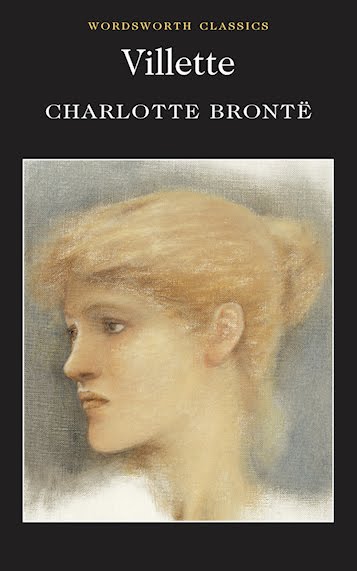
Lucy Snowe, a young Englishwoman of the educated class, narrates the story of her life—in a particularly partisan and sometimes unreliable manner. She is left destitute after the death of her mysterious family and, after briefly being a nurse-companion, takes herself off on a blind, daring trip to the Continent. She goes to the kingdom of Labassecour (perhaps modeled on Belgium) and, through a series of very fortunate occurrences, manages to land herself a job and a place to live on her first night in the town of Villette. She becomes a nursery governess to the three daughters of the proprietress of a large school for girls. During her time as the bonne d'enfants, she impresses her employer, Madame Beck, with her modesty and excellent English. She is elevated to the position of English teacher, though she has no qualifications for it and has a poor command of the French language spoken in Villette. Lucy, however, comes to excel at teaching and to love it.

Dr. John Graham Bretton, a friend of Lucy’s in her childhood, also happens to be working in Villette. Their paths cross, but he does not recognize her. During this time Lucy and a student at Madame Beck's, Ginevra Fanshawe, become friends, and Lucy learns of Ginevra's secret suitors. One of them is Dr. John, for whom Lucy has also formed an attachment. Ginevra is fickle and selfish, and Lucy cannot understand how Ginevra could prefer another (the Count De Hamal) to her adored Dr. John. Meanwhile, the imperious and difficult M. Paul, a professor of literature, is paying Lucy attention, but chiefly to admonish her and instruct her about what he considers proper conduct for a young lady.

Two more friends from Lucy's childhood, Paulina Home and her father, now live in Villette. Mr. Home has inherited a title and a fortune, and he and his daughter live in fine style. Paulina (Polly), who is younger than both Dr. John and Lucy, stayed with the Brettons when a young child and formed an interestingly adult attachment to Dr. John. Dr. John, who was enamored of Polly's flighty cousin Ginevra, now transfers his affections to the seventeen-year-old.

During this time Lucy is visited by a spectral nun, said to the be the shade of a sister buried alive in the garden when Madame Beck's school was a convent. Lucy learns that M. Paul, with whom she has had several battles but has formed a friendship, was engaged to be married twenty years ago to a woman named Justine Marie. Because of debts and the unforeseen death of M. Paul's father, the two were unable to marry, and she died very young in a convent. M. Paul supports Justine's family in a house with a priest named Pere Silas. Lucy also learns that M. Paul lives quietly in two rooms at a nearby boys' college, keeping no servants.

Lucy and M. Paul become very good friends, and he calls her his sister. At one moment, however, Lucy thinks that perhaps M. Paul feels more strongly for her. He tries to convert her to Catholicism, but Lucy is a truly faithful believer in the Protestant faith of her upbringing, and becoming a Catholic for her is not possible. Though the two finally come to some agreement on the relative worth of their faiths, it is clear that Lucy's Protestantism will keep her from ever being M. Paul's wife. Pere Silas and Madame Beck counsel M. Paul that marriage to Lucy is an impossibility, and M. Paul decides he must go to Guadalupe to take care of some business interests of Madame Malravens.

Dr. John and Polly fall in love. They exchange letters, hoping to become engaged. M. de Bassompierre is against letting his daughter go, but he eventually relents. The couple marry and are happy, having many healthy children. Ginevra, formerly loved by Dr. John, is now jealous and dislikes her cousin Polly.

M. Paul and Lucy fall in love, but she is not a Catholic, and the decision has already been made for him to leave. Before he goes he is very mysterious and does not see Lucy until the night before his departure. He has procured a house for her to set up a new school so that she may be independent and wait for him to return from Guadalupe. They exchange pledges of love, and M. Paul leaves.

Ginevra has been seeing the Count De Hamal secretly. He has been visiting her at the school dressed as the spectral nun. On the night Ginevra elopes with the Count, it is revealed to Lucy that the ghostly visitation was nothing other than Count De Hamal in disguise. Lucy is relieved that she has never seen a ghost.

Lucy leaves the school and prospers at her own school while she waits for M. Paul's return. She receives an unexpected legacy from an old friend, with which she turns her day school into a boarding school. The ending of the novel is ambiguous, but it is implied that M. Paul dies in a shipwreck on his way home. Lucy lives out her life alone, at least comforted by the memory of love.

THE HEROINE , LUCY SNOWE

Lucy Snowe is a great enigma. One of the most complex and undefinable female characters of my many literary reads. Like in Jane Eyre, one of her main features is solitude, loneliness. But this is easy to recognize.

"I kept up well till I had partaken of some refreshment, warmed myself by the fire, and was fairly shut into my own room; but as I sat down by the bed and rested my head and arms on the pillow, a terrible oppression overcame me. All at once my position rose on me like a ghost. Anomalous, desolate, almost blank of hope, it stood. What was I doing here alone in great London? What should I do on the morrow? What prospects had I in life? What friends had I on earth? Where did I come? Whither should I go? What should I do?"

More difficult is to draw a definite portrayal of her . She is shadowy, so not easy to be perceived distinctively. So shadowy that her rname is only revealed in chapter 11. She herself as a narrator doesn’t easily find a way to tell us about what she really likes, thinks, wants. Who is she actually? It seems she doesn't mind to be seen as M. Paul Emanuel sees her, but she also likes being discreet as a shadow in Dr Bretton’s eyes .

“What contradictory attributes of character we sometimes find ascribed to us, according to the eye with which we are viewed! Madame Beck esteemed me learned and blue; Miss Fanshawe, caustic, ironic and cynical; Mr Home, a model teacher, the essence of the sedate and discreet: somewhat conventional perhaps, too strict, limited and scrupulous, but still the pink and pattern of governees- correctness; whilst another person, Professor Paul Emanuel, to wit, never lost an opportunityof intimating his opinion that mine was rather a fiery and rash nature – adventurous, indocile, and audacious. I smiled at them all. If any one knew me it was little Paulina Mary.”

She’s even rather unreliable as a narrator. She disguises feelings, facts and hides people’s real identities . She only unveils the truth when she decides it is time in the story. But she is painfully honest to herself and to the others as a character in the same story.
Surely she’s strong – willed, independent and passionate.Though, somewhere on line , I’ve read a review which considered her cold and unsentimental - hence her surname , Snowe. Instead , I think she is capable of conceiling and dominate her feelings which, anyway, are there deeply rooted inside her. I can’t see her as detached,  if not apparently. She’s capable of great sufference , on the contrary, and can be very sympathetic with those she likes and loves. She can also dislike and despise, but never hate.

She dearly love John Graham Bretton and is loyal, grateful and affectionate to awkward , brooding M. Emanuel. She likes Mrs Bretton, her god-mother, and M. Home,  Paulina’s father. She needs to be loved and appreciated, she longs for it, but she seems not to care, she seems to prefer to remain in the shadow.

Lucy's interior battle , most of the time, is between wanting to remain in shadow and wanting to be lit up in brilliance. Before Mme Beck's fete, the girls of the pensionat at which she is an English maitresse assemble to be coiffed, dressed and arrayed. Lucy is swept up in their activities and reflects:
"In beholding this diaphanous and snowy mass, I well remember feeling myself to be a mere shadowy spot on a field of light; the courage was not in me to put on a transparent white dress: something thin I must wear - the weather and rooms being too hot to give substantial fabrics sufferance, so I had sought through a dozen shops till I lit upon a crape-like material of purple-gray - the colour, in short, of dun mist, lying on a moor in bloom. My tailleuse had kindly made it as well as she could: because, as she judiciously observed, it was 'si triste - si peu voyant', care in the fashion was the more imperative: it was well she took this view of the matter, for I had no flower, no jewel to relieve it: and, what was more, I had no natural rose of complexion.We become oblivious of these deficiencies in the uniform routine of daily drudgery, but they will force upon us their unwelcome blank on those bright occasions when beauty should shine.
However, in this same gown of shadow, I felt at home and at ease; an advantage I should not have enjoyed in anything more brilliant or striking.

Shadows will haunt Lucy throughtout this story. She is comfortable in her "gown of shadow" , comfortable so long as it is of her own choice. She refuses to become Paulina's , Miss de Bassompiere’s,  companion maid.

“I was no bright lady's shadow - not Miss de Bassompierre's. Overcast enough it was my nature often to be; of a subdued habit I was: but the dimness and depression must both be voluntary - such as kept me docile at my desk, in the midst of my now well-accustomed pupils in Madame Beck's first classe; or alone, at my own bedside, in her dormitory, or in the alley and seat which were called mine, in her garden: my qualifications were not convertible, nor adaptable; they could not be made the foil of any gem, the adjunct of any beauty, the appendage of any greatness in Christendom”

However,  a shadowy nature imposed is repugnant to her . When Graham, the golden idol of her heart, calls her an "inoffensive shadow," she remarks:

I smiled; but I also hushed a groan. Oh! - I just wished he would let me alone - cease allusion to me. These epithets - these attributes I put from me. His 'quiet Lucy Snowe,' his 'inoffensive shadow,' I gave him back; not with scorn, but with extreme weariness: theirs was the coldness and the pressure of lead: let him whelm me with no such weight.

When she is forced to come out of shadow wearing a less misty colour, a horrifyingly pink dress. Upon going to a concert with Graham and his mother, she ‘s almost terrified:

"I thought I should not: I thought no human force should avail to put me into it. A pink dress! I knew it not. It knew not me. I had not proved it.

Without any force at all, I found myself led and influenced by another's will, unconsulted, unpersuaded, quietly over-ruled. In short, the pink dress went on, softened by some drapery of black lace. I was pronounced to be en grande ténue, and requested to look in the glass. I did so with some fear and trembling; with more fear and trembling, I turned away. Seven o'clock struck; Dr. Bretton was come; my godmother and I went down. She was clad in brown velvet; as I walked in her shadow, how I envied her those folds of grave, dark majesty!"

GOTHIC AND SUPERNATURAL FEATURES
As I wrote in another of my posts for the All About The Brontes Challenge, Gothic Brontes,  gothic elements are recurrent in the three sister's novels from Jane Eyre to Wuthering Heights, from The Tenant of Wildfell Hall to Villette (though I didn't mention Villette because I hadn't read it yet).

For example, on the night of Miss Marchmont's death, Lucy takes a storm as a portent of that event. Lucy philosophizes that the unsettled weather, coupled with news of catastrophic events in distant places, often predicts calamity at home. This Shakespearean or classical view of weather borders on ideas of the supernatural, implying that the weather and planet-wide events either predict or affect individual human activities. Storms and weather reflect the action of the book in many instances: Lucy's collapse in the Basse-Ville is in a terrible rainstorm, the coldness of the snowstorm outside enters Lucy's heart when she first beholds the growing closeness between Polly and Dr. John, and so on.
In Chapter XII, instead , an allusion to an old ghost story prefaces a gaze at the moon, a violent storm, and an important meeting between Dr. John and Lucy. The ghostly visitations of a nun  (though in the end we know their cause) in the attic and garden are meant to show Lucy's own inner fears as well as her ability to face down, bravely, what could send others into hysteria. While Brontë never crosses into the truly preternatural or magical realm (by never asserting that anything supernatural is true), it is clear that Lucy believes that these events are pertinent to the course of human affairs. These supernatural references often serve as metaphors for something unsaid but tacitly acknowledged, like Lucy's buried life or Miss Marchmont's fury at God.

CONCLUSIONS

There are so many things more  I might have said about this read but I think my posting is already too long . Such a complex, fascinating novel deserves a second and even a third reading in time as well as other reflections and thoughts.

I want to conlude my analysis sharing with you a quote from the interesting introduction to my edition.
Dr Minogue says:
“Villette will continue to disturb and subvert., not only through its revolutionary examination of female identity, but in its representation of the shifting nature of human identity, its hiddenness, the final unknowableness of one human being to another. That it is able at the same time to make the reader feel the deepest sympathy both for those who float easily on life’s surface and for those who struggle bravely with life’s painis C. Bronte’s consummate achievement.”

THIS IS ALSO ONE OF MY TASKS FOR


(Have a look at my right sidebar for the other tasks!)

18/06/2010

RA FRIDAY - RICHARD AND THE SAS : ULTIMATE FORCE vs STRIKE BACK

(IF YOU HAVEN'T SEEN THIS SERIES YET, I MUST WARN YOU : SPOILERS!)

I wanted to make a comparison between the two series in which Richard plays an SAS soldier / officer. And , since I didn’t mind Strike Back at all, I was ready to re- watch ITV   Ultimate Force (2003). Good God! I had completely removed the silliness of the entire thing! I was just shocked and angry in the end. Furious ! And only when I was,  I remembered it was not the first time! Did British television really broadcast that stuff? Unbelievable and unacceptable!


SAS soldiers overeager to shoot on any possible occasion, ready to lie and to find a capegoat to conceil their mistakes , the regiment before anything or anyone else , catastrophic family relationship but … yeah … they are tough guys , no frailty must be shown. Plenty of aggressiveness and high-handedness, uncaring attitude towards the application of the law, personal revenge. MAD DOGS, indeed (it is the title of one of the episodes). I know this show was meant for lads but such uneducative, immoral, distorted messages should not be sent to any audience, least of all to our youth. I know most of the people who take up a military career must be something like that, but please, don’t glorify them on a TV show!


I don’t like Henno (Ross Kemp) at all! Did his wife leave him? Well done! Doesn’t he say he married her only for her teets? Unbearable! Then? He shouts all the time giving order here and there even when he is not on duty. He ‘s ready to … no more precisely , he lies to the tribunal judges in the first episodes but he can’t bear any betrayal to him or to his friends. In that case he decides what justice is and do justice himself. Just a puffed –up, megalomaniac , crazy but lucid bloke. Blonde MI5 female agent, you are warned. Ex –wife, you just did the right thing!


I don’t like Pete, Laura’s husband. He’s in troubles, shocked and traumatized, removed from ops . He nearly kills his wife in his sleep, he’s paranoic, crazy, violent. I found it difficult to sympathize with him and with his silly wife. Henno helps him, of course. Even his wife – apart from a brief affair with kind- blue-eyed- Ian-Richard– is there always patient to him, everybody’s there for him. I found him unbearable, instead. He is even reactivated after a while though still mentally unstable. He refuses to undergo therapy: he is a man, after all, an SAS soldier, not a maid! I think he is just an irresponsible. He and his friends who cover the truth. They don’t help him at all, in fact.


I didn’t like any of the plots in  the 6 episodes. After watching 8 series of Spooks and the new Sky 1 Strike Back,  I may be a little spoilt or too demanding. But this series was utterly … crap! Chris Ryan collaborated to the scripts in the first two series but then he left. He was certainly scandalized by the unrealistic twists the story was taking. Most of the cast too left in series 3, maybe the scripts were becoming even more absurd.


 Ian Macalwain is not an easily likeable character and he's nothing like Richard, but as a thoroughful talented actor,  he did is best in that situation too. Macalwain is the new arrival in the Red Troop, he has to substitute the previous captain all the guys there used to like very much. Not an easy task.
He doesn’t want to be liked, actually.He wants to be respected and obeyed,  since he’s been appointed the new responsible of the troop. All the men, instead, start working against him, ignoring his orders, especially Henno.


No one better than Richard can find the right words to describe what he had in mind while acting in UF:

“Macalwain is not a bad guy, but he is a bit edgy. I don't think I am anything like him, which is why it is interesting to play him. He's eloquent with a sharp tongue and can humiliate people in an argument, which was really enoyable to play. He comes in as a captain and throws his weight around.


Macalwain begins to grow close to Laura, the wife of one of his men, Pete Twamley. Although ultimately it is she who seduces him by coming to his hotel room, he is soon so deeply involved with her that he is prepared to give up his career to take her away from her violent husband. Horrified, she pulls back, not wanting to leave Pete. But Macalawain is unable to accept this, believing that eventually she will come away with him.

By this time, Henno has found out that Macalwain has slept with Twamley's wife - the ultimate betrayal in his eyes. In the final episode, he takes matters into his own hands during a mission to rescue Colonel Dempsey, the regiment's commanding officer”. (from www.richardarmitageonline.com)

Henno takes matters into his hands ?!? Would you say that a cool blood murder ,with final mocking hiding of the corpse in a freezer and  knowing smiling looks from all the members- officers- included,  is TO TAKE MATTERS INTO ONE’S HAND? Who do they kill? Ian of couse. And why? Because he left Pete’s wife seduce him!


As I told you at the beginning of this post I was just astonished and furious. I couldn’t believe my eyes. The series closes that way. At the beginning of series 3 none of them takes their comeuppance. Nothing happens!

What is the main  difference between Ultimate Force and Strike Back? A great one, indeed. On a shallow note, Richard has greatly improved his look recently. But, seriously, everything sounds more realistic and more human in Sky 1 new series. John Porter is a killing –machine but in order not to suffer for what he does, he kind of suspends reality, dissociate himself from his own actions while killing and, especially, never seems overeager or excited to do it. It just seems an unavoidable cruel necessity to him. He’s got feelings, regrets, nightmares for what he does. He’s got frailties and flaws. The characters responsible for killings and massacres in SB suffer from great or little sense of guilt, but they recognize their mistakes: John Porter, , Gerald Baxter, Collinson himself in the end. The attempt to give a soul to a war killing machine like John Porter was a successful one. It made him someone bearing a torment, someone who needs to atone, someone you can even forgive for his crimes. You’ve got the idea that war is sufference and death, not a game. That’s what counts more to me.


Awfully done, ITV. Well done, Sky one!


P.S. 1
It seems Strike Back will take part to Rome Fiction Festival next July. Let’s see if Italian Press will notice its talented protagonist. Fingers crossed for any news coming out!

P.S. 2
Have you seen SB DVD extras? There’s a long interesting interviews with the crew and Richard says lots of thoughtful things about his experience. I just love listening to him talking about his work and his characters.

Many thanks to my friend Karen for her snappies from Ultimate Force, to www.richardarmitageonline.com for the precious info about Richard's work and to www.richardarmitagenet.com for their incredible screencap gallery.

17/06/2010

THROWBACK THURSDAY - THE HOURS by MICHAEL CUNNINGHAM ( 1998)

For this event hosted by Jenny at TakeMeAway , this time I've chosen a beautiful novel I've been recently thinking about since I  re-read  MRS DALLOWAY by Virginia Woolf with my students. THE HOURS by Michael Cunningham is just dedicated to Woolf and her 1925 novel.
Throwback Thursday is a corner to write about good reads from the past. Those books we so much loved and we don't want to forget .


Passionate, profound, and deeply moving, this novel is Cunningham's most remarkable achievement to date, Winner of the Pulitzer Prize for Fiction and the PEN/Faulkner Award. To me it is one the most beautiful and unforgettable reads of the last 10 years.


Michael Cunningham, widely praised as one of the most gifted writers of his generation, draws inventively on the life and work of Virginia Woolf to tell the stories of three different women: Wirginia Woolf herself in the last days of her life before her suicide early in WWII, coping with the troubled writing of her “Mrs Dalloway”; Clarissa Vaughan , an editor living in today New York city , caught in her attempt to organize a party for Richard, her most loved friend and ex-lover who is dying from AIDS; finally, Laura Brown a housewife living in California in the years soon after the War, who dreams to escape her boring ordinary life at least for one day, one day only ...What is the link between the three women? Apparently a very subtle thread: Virginia is writing Mrs Dalloway , whose name is Clarissa like Mrs Vaughan living in today’s New York city, which is also the book Laura takes with her in her brief escape from her world. But the reader will discover deeper connections page after page, till the final surprising revelation .


This novel is Cunningham’s homage to Woolf’s great talent and what I most admired in his style was the capacity to tell the three stories into one recalling Woolf’s indirect interior monologue, very often recalling/quoting her Mrs Dalloway.

Only literature can give sense to our confused, slanting lives. Moreover, literature is the mirror in which life reflecting its image succeeds for an instance to tell about itself. Woolf’s moments of beings are in Cunningham, too. Revelations of life itself.

You can understand how poignantly beautiful this novel is just tasting its Prologue. Three pages I love re-reading from time to time. Do it yourself, here.

Trivia

- On her way to Richard's apartment, Clarissa Vaughan thinks she sees Meryl Streep. Meryl Streep ended up playing Clarissa Vaughan in Stephen Daldry's movie adaptation of "The Hours". In the book, Clarissa Vaughan considers it might also have been Vanessa Redgrave that she saw. Curiously, Redgrave plays the part of Clarissa Dalloway in the 1997 film version of Mrs Dalloway.

- Mrs. Brown is a character in Virginia Woolf's essay, "Mr. Bennett and Mrs. Brown".

- Two anachronisms are presented by Cunningham in his book. The first is on page 30 (1998 edition) where he writes of Virginia Woolf, "She rises from her bed and goes into the bathroom." Hogarth House was built in 1720 and in 1923, it did not have a bathroom, only an outhouse. The second is on p. 43 where Mrs. Brown in 1949 sees "beside the roses stand cereal box and milk carton..." Although Lucerne Dairy did have milk cartons in 1938, they did not come into common use until the 1960s. These are both corrected in the film Woolf is depicted using a ewer and basin to wash in the morning, and the Browns have milk in a bottle.


After reading the novel, I suggest you to watch the movie (2002) .
It’s actually worth seeing!

16/06/2010

JANE IN JUNE GOES ON - GIVEAWAYS, INTERVIEWS & A NEW FILM

JANE IN JUNE goes on for me. I'm  re-reading PERSUASION. I've recently posted twice on My JA Book Club, once introducing the novel and listing some simple questions from my precious book of quizzes, the second time today with some Thoughts on Anne Elliot, this month's heroine.

LOTS OF GIVEAWAYS
This event,  hosted on Book Rat by Misty,  is featuring interviews and great giveaways. Among the guest writers,  my blogger buddy Jane GS, Jane Greensmith.
Here's her interview with Misty and the post with her double giveaway . I particularly loved reading her short stories in the collection Intimations of Austen. Read my review and my interview with Jane. Follow my links, comment and get a chance to get your copy of these jems of Austenesque pleasure.
Alexa Adams is another talented writer of Asten-based fiction, who is also a dear blogger buddy of mine, she wrote an entertaining guest post on Misty's blog, about  the  Concerns of a Crazy Janeite, that is herself! She is also giving away a copy of her First Impressions, A Tale of Less Pride and Prejudice which I had the pleasure to read and review not long ago, after receiving my signed copy directly from Alexa (my review and  my interview). If you want to enter this giveaway, click here and leave your comment!

Don't forget the giveaways running on through all this month on Fly High! and My JA Book Club.
Just have a look at my sidebar!


A NEW PERIOD FILM COMING SOON!
Now,  since we are in an Austenesque mood, I 'd like to close this short posting of mine with some news about and images from a period film coming out soon and starring three Austen heroines! Keira Knightley (Lizzie Bennet 2005), Carey Mulligan (Kitty Bennet 2005) and Sally Hawkins (Anne Elliot 2007), as well as Charlotte Rampling and Andrew Garfield.


In his highly acclaimed novel Never Let Me Go, Kazuo Ishiguro (The Remains of the Day) created a remarkable story of love, loss and hidden truths. In it he posed the fundamental question: What makes us human? Now director Mark Romanek (One Hour Photo), writer Alex Garland and DNA Films bring Ishiguro's hauntingly poignant and emotional story to the screen.


As children, Ruth (Knightley), Kathy (Mulligan) and Tommy (Garfield), spend their childhood at a seemingly idyllic English boarding school. As they grow into young adults, they find that they have to come to terms with the strength of the love they feel for each other, while preparing themselves for the haunting reality that awaits them.

15/06/2010

MY SUNNY, LOVELY SUNDAY

Yes, I know, it’s Tuesday but I had no time to write in the last couple of days. I’m supposed to be on holiday since I stopped giving lessons, but , do you know teachers go on working after that? So, I’ve just found some time to write down a brief report of my delightful Sunday!

I live near Rome, among beautiful mountains and in wonderful wilderness. My town  (Subiaco, on the left,  medieval bridge)  is small and ancient and I love living here. I am always rather busy at weekends and I stay at home coping with the housework left behind in weekdays. Last Sunday I was invited to join two special friends on a trip and decided to leave everything apart: school deadlines and ironing piles, husband and sons!

Ariccia and Nemi are very picturesque small towns I had never been to, they are really close to Rome. The landscape is similar to the one I’m used to , but they are near volcanic lakes, just pretty spots of greenish blue among the mountains. I am usually so attracted by lakes and the sea! But it is odd because I’m afraid of water and can’t swim.

(Ariccia - Rome)

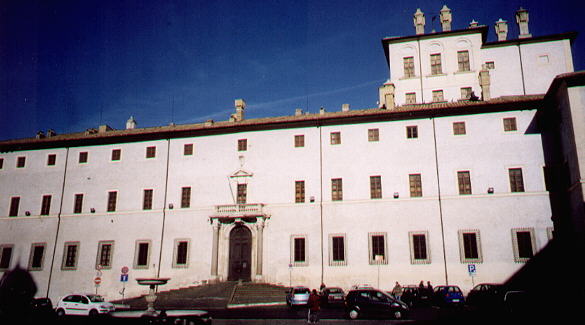
In the morning we visited Palazzo Chigi in Ariccia, a luxurious baroque country residence, which belonged to one of the most powerful families in Rome. It was given to the City of Ariccia on 29th December 1988 under special conditions, by Prince Agostino Chigi Albani della Rovere, and is now a museum and cultural centre, hosting various activities such as exhibits, concerts, guided tours, meetings, and the like.
Begun in the second half of the sixteenth century by the Savelli family, the palace was transformed into a lavish baroque home between 1664 and 1672 using plans by Gian Lorenzo Bernini, with the collaboration of his young student Carlo Fontana.
The most curious place  in the palace is called , “la stanza delle belle”, the room of the beauties; in it, Cardinal Flavio Chigi collected the portraits of his beauties … his lovers!There are so many on those walls, not all of them so beautiful,  but Cardinal F. C. didn’t waste much of his (free) time!

This stunning location has been used to shoot period series and movies more than once. The most remarkable of them is Luchino Visconti ’s “Il Gattopardo” ( The Leopard, 1963) starring Alain Delon, Burt Lancaster and Claudia Cardinale.


It was not only Art and History, mind you! We ate in a typical “fraschetta” (inn) in Ariccia … we ate a lot of genuine, tasty food at a very special price. They said it was an appetizer but , good God! … it was impossible to finish all that goodness!

After lunch we moved to Nemi, a pretty ancient resort overlooking a small volcanic crater lake. We had our dessert there, a very special one, “fragoline di Nemi” (strawberries from the area) with ice- cream. A delicious tasty completion for a great trip. We sat on a terrace, admired the lake, tasted the strawberries and chatted pleasantly. We were free to share our opinions on everything we like or dislike :  books, Tv series, colleagues (we work in different places and they are not teachers like me, lucky them!) , families , next holidays, dream holidays, friends … yes … we talked a lot… am I forgetting anything …? Well, a certain Brit bloke. A tall, dark, handsome guy ... He was very often the subject of our conversation. Any guess?

(Nemi - Rome)

What a lovely Sunday! Thanks to my friends for planning it and driving me there! It was just the right way to gather some enthusiasm and energy to start the school meetings I’m having these days. They can be stressing, they are the worst part of my job: assessing and deciding who fails, who passes ... not easy matters, not stuff that I particularly like.

I only regret I forgot my camera! These pictures are taken from the Net!!!

14/06/2010

GIVEAWAY WINNERS!


1. PHYLLY'S GIVEAWAY - MRS GASKELL'S COUSIN PHILLIS

As I announced, this week I'm going to be very strict. Only commenters who added their e-mail addresses have been entered. I'm very sorry for the others,  if they wanted to be entered but  forgot to do it. So, finally,  the  readers/commenters of Phylly's interview on Fly High entered for her giveaway are:
1.Ruth
2.BuddyT
3.Time4t
4.Avalon
5.Iz4spunk
6.Krist
7.Claudia
8.Luthien84
And the winner is ...

CLAUDIA !!! CONGRATULATIONS!!!

2. CHARLOTTE HAWKINS'S DOUBLE GIVEAWAY - THE TEMPEST


Sarah Pawley's, pen-name Charlotte Hawkins, interview and giveaway arose some true interest among many of my readers but only those who added their e-mail addresses to their comments were entered. Here they are:
  1. Ana T.
  2. Marianna
  3. Iz4spunk
  4. Nancy
  5. Felicia
  6. Lunarossa
  7. Mesmered
  8. Buddyt
  9. Adibah
  10. Theresa N.
  11. WhiteLady3
  12. Aik
  13. Luthien84
  14. Krist
And the  winners are ...


NANCY & LUTHIEN84!!! CONGRATULATIONS!!!

Many thanks to Phyllis and Sarah for their availability, their friendliness and their generosity! Have you visited their blogs? You can find Phyllis at Phylly's Faves and Sarah/Charlotte at From the Quill Tip . If you haven't won this time there are other giveaways running all through the month here at Fly High! Have a look at my right sidebar and leave your comments and e-mail addresses! Off to write to today's  lucky winners.