Showing posts with label Italian literature. Show all posts

18/10/2023

CELEBRATING 100 YEARS OF ITALO CALVINO: FINDING LIGHTNESS IN THE INFERNO


This year marks the centennial celebration of the remarkable Italian writer Italo Calvino. As an Italian and a devoted reader of his works, I find myself compelled to share the profound impact that his words and ideas have had on me. While my blog, FLY HIGH, primarily caters to an English-speaking audience, including many Americans and native English speakers, the universal themes in Calvino's literature make this tribute a perfect opportunity to engage with an international audience.

15/10/2014

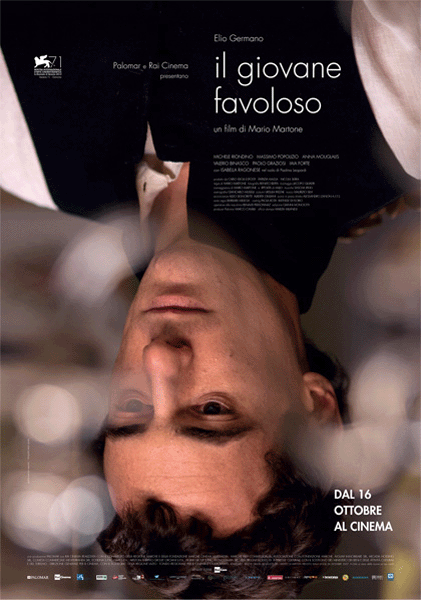
PERIOD & MORE PERIOD - AT THE CINEMA: IL GIOVANE FAVOLOSO


“Freedom is the dream you dream
While putting thought in chains again --” 

Il Giovane Favoloso directed by Mario Martone is an Italian movie which participated in Venezia Film Festival last September. I was lucky enough and I could see it in a special premiere for teachers in Rome, before  it will be released in theatres on 16th October.

The film is a biopic of Italian Romantic poet, Giacomo Leopardi (1798 - 1837). Italian students inevitably meet him on their path through high school and two are the chances: either they love him or they  hate him. Impossible to remain indifferent.
For me it was love at first line, when I studied his poems in my final year at high school. I felt like that genius young man from a distant time could read my deepest thoughts and put them on paper in powerful words.

Touching and at times disturbing, his pessimism and his humanity, his melancholy and his sufferings, have stayed with me while turning into an adult.  I still treasure those poems as remarkable moments of  self-realization and growth.

Said that, you may guess my watching this film couldn't be nothing less than an emotional experience: it was something like meeting Leopardi in the flesh and finally giving him a body and face, while in my mind he had only been a voice.

24/07/2014

SUMMER IS FOR READING: THE FAULT IN OUR STARS & OTHER LOVE STORIES

I've been reading quite a lot  in these lazy summer days. That's what summer is for,  in my case. I didn't manage to read much in the past year, so it is the perfect time to catch up, to read as much as I can, both in English and in Italian. I'm sure I won't manage to be completely satisfied in the end,  since to hope to go through all my ambitiously endless TBR list is utopian, but, at least,  I'll try to  make my read-in-2014 list a bit longer.

The latest two books I added to the latter are both romance fiction novels in the star-crossed-lovers/ don't-forget-your-tissues section.
Jokes apart, they are both novels I won't easily forget. I  love them.  Both, as different as they are.

The Fault in Our Stars

"The fault, dear Brutus,  is not in our stars but in ourselves, that we are underlings". Probably John Green had this line from Shakespeare's Julius Caesar in his mind while trying to give his beatiful love story a proper title. But more probably, more than Julius Caesar, he had Romeo and Juliet in mind (... A pair of star-crossed lovers take their life/ Whose misadventured piteous overthrows / Doth with their death... ) , while writing the story of Hazel Grace Lancaster and Augustus Waters. Shakespearean influences apart, the author was really inspired while depicting his two young protagonists with black letters on white pages: they are two of the loveliest,  liveliest teenage characters I've ever encountered.

20/04/2014

IN WAR THE WORDS OF A POET CAN SAVE LIVES, IN LIFE THE WORDS OF A POET CAN MAKE THE DIFFERENCE: MEETING ERRI DE LUCA

"... in war the words of a poet can save lives ...
in war the orphans and those without a book have no refuge"  

Erri De Luca's original first name was Henry, an homage to his grandmother, who had American nationality, but defined by him as an "accident". He eventually decided "to change" few letters by Italianizing his name as Erri. 
Meeting Erri De Luca at the library in my town a few days ago was something unexpectedly important.
Do you know when you have the impression that a person speaking to an audience is instead speaking to you, just to you, that those words are meant for you?
Strange enough, especially because I couldn't see his face (see picture, I'm sitting on the right). But that is what I felt sitting behind,  right behind him, behind that table on which the widely popular and highly appreciated Italian author was informally sitting while talking to us. I was at his back and could watch his shoulders slightly bent forward, his slim figure in a comfortable blue suit, moving to the rhythm of his placid voice and turning left, then right, to direct the blue-eyed piercing stare to each and every one facing him.

30/05/2013

BOOK REVIEW - QUANTA STELLA C'E' NEL CIELO BY EDITH BRUCK (2009) - SOON AN INTERNATIONAL MOVIE, ANITA B., BY ROBERTO FAENZA


I came to read this book after hearing that Italian director Roberto Faenza was making a movie out of it  (Anita B.) and I’m so  glad I discovered both novel and author. It’s been a great read which I happened to find  just when I was working on 20th century literature with my oldest students.  I couldn’t actually use it in my lessons,  since it hasn’t been translated into English and I teach English not Italian  literature,  but I think it gave indirectly a great contribution to my introduction of the general  background context and to  suggest my students connections and links coming directly from witnesses who lived and survived the tragic reality of WWII.

There's no grammar mistake in the title, it was just meant to sound "How much star is there in the sky",  like in   Sàndor Petöfi's ballad.  
Edith Bruck,  like Anita the young protagonist of  “Quanta stella c’è nel cielo”,     survived being imprisoned in a concentration camp and this is what makes the narration even more touching though it is never too sentimental nor melodramatic.  

 Edith Bruck won the Premio Viareggio Narrativa 2009 for this novel. She’s been living in Italy  since soon after WWII and has become a writer in the Italian language since the Hungarian tongue brought painful memories back to  her mind, the memories of being a rejected, persecuted Jewish child imprisoned in several Nazi concentration camps (Auschwitz, Dachau, Bergen-Belsen). 
She tells she  couldn’t even say “ciao” in our language when she arrived in Rome as a  desperate orphan, but wanted to learn Italian and use it in order to be born again,  into a new life, in order to forget those memories which were  poisoning her. 
She felt welcome here in our country. Italy and her were extremely poor at that time and she felt immediately at home in Rome. The experience  of Anita B., the protagonist of the book, is quite different, though. 

25/03/2012

IN MEMORY OF ANTONIO TABUCCHI, A FREE MAN AND A GREAT NOVELIST

If you don't know who Antonio Tabucchi was, read this short bio note HERE. However,  he was a free man and a great novelist. Today  he died in Lisbon, a city he loved as his second home.
I'm not going to say much about him. I'll just use his words to remember his commitment
"Democracy isn't a state of perfection," Tabucchi said. "It has to be improved, and that means constant vigilance."
And also:
“Maybe I’m not happy about what’s going on in Portugal, admitted Pereira. Senhora Delgado took a sip of mineral water and said: Then do something about it.” (Pereira Declares)
Well, Antonio Tabucchi was someone who always ... did something about it,  all his life through. Italian politicians know that and I really hope they won't say a word on occasion of Tabucchi's death. They owe him  the respect of silence. 


Here is a post I dedicated to his Pereira Declares some time ago on FLY HIGH!