Showing posts with label Emily Bronte. Show all posts

26/03/2017

WUTHERING HEIGHTS 2018 - INTERVIEW WITH PAUL ERYK ATLAS: BECOMING HEATHCLIFF

Shao'ri Morris and Paul Eryk Atlas in a scene from Wuthering Heights


Though he may apparently look quite the brooding Romantic hero, he shares very little with the protagonist of Wuthering Heights. He is no Heathcliff at all.  Paul Eryk Atlas loves smiling, is the least vengeful creature in the world and has such a joyful disposition that he had fun even answering my teacher-mode questions and made this interview such fun to read! 
I can't wait to see Paul on screen when the new Wuthering Heights will be out in 2018 to celebrate Emily Bronte 200th birthday anniversary!    

01/03/2017

WUTHERING HEIGHTS 2018: THE TRAILER IS OUT! + INTERVIEW WITH DIRECTOR NINA ELISAVETA ABRAHALL


Last week I posted the first installment in my Wuthering Heights 2017 series: my interview with Shao'ri Morris, the actress starring as Catherine Earnshaw in the upcoming movie. Today I've got not one but two absolute exclusive features: the fist trailer and an interview with director and screenplay writer, Nina Elisaveta Abrahall. She kindly answered all my questions, even the most insidious ones, with generosity and open-mindedness. You know, I even dared ask whether we truly needed a new version of Emily Bronte's novel after so many had been already made. I think she has a point there! Discover more reading through the interview and enjoy the trailer at the end of the post! By the way, my next interview is with Heathcliff, that is Paul Eryk Atlas.  Stay tuned!

24/02/2017

WUTHERING HEIGHTS 2018 - BECOMING CATHERINE EARNSHAW: INTERVIEW WITH SHAO'RI MORRIS


Emily Bronte wrote the greatest , most terrifying love story of all time: Wuthering Heights.  It is a wild, passionate tale of the intense and  demonic love between Catherine Earnshaw and Heathcliff, allegedly a Gypsy foundling adopted by Catherine's father. After Mr Earnshaw's death, Heathcliff is degraded and humiliated by Catherine's brother Hindley and wrongly believing that his love for Catherine is not reciprocated, leaves Wuthering Heights, only to return years later as a wealthy and polished man to find he is too late and that Cathy has married Edgar Linton. He proceeds to exact a terrible revenge for his miseries.Unable to bear being parted from his love he curses her on her deathbed to never rest and always be with him and so begins 20 years of her haunting his every waking and sleeping hour. A tale of love, hate, horror, haunting, but most of all a story about human nature. 

01/04/2010

GOTHIC BRONTES

Though they lived in the Victorian Age and published their novels in those years, the three Bronte sisters share a great deal with the Romantic Age in their works: themes, literary devices and features, wild nature and tormented souls. For example, Charlotte’s Mr Rochester or Emily’s Heathcliff embody the typical Byronic hero: moody, restless, wild in manners, tormented but so attractive. The heroes and the heroines in their novels tend to be atypical, anti-conformist, unable to simply accept their duties. They are often led by feelings and passions. And all of that is not typically Victorian. The reading audience was shocked by Emily’s Wuthering Heights (1847). (I still am sometimes re-reading it: she was so brave at writing and publishing such a novel at that time)

A literary taste the three writers share is that for Gothic elements. And this is what I want to point out in this post I prepared for The All About the Brontes Challenge.

Gothic novels were very popular at the end of the 18th century (the first one was published 1764 by Horace Walpole and was titled The Castle of Otranto) and their popularity went on through the Romantic Age. Lord Byron and his friends, among whom P.B. and Mary Shelley , spent their nights together reading and discussing gothic tales and they even proved themselves at writing one , but only Mary Shelley wrote something as worthy to be remembered as her Frankenstein (1818).

Gothic novels were based on frightening characters and events and had risen thanks to Edmund Burke ’s new conception of the sublime as “horrible beauty” whose main source was fear. What is Gothic then in our beloved novels by Charlotte, Emily and Anne Bronte?


1. In Charlotte’s JANE EYRE (1847) we can recognize many  Gothic features
 Jane’s childhood terrors in Lowood school
 Thornfield mysterious nocturnal incidents
 A sense of supernatural
 The gloomy atmosphere
 Bertha’s madness
 Jane’s (apparently) unrequited love

2. The same can be said for Emily’s WUTHERING HEIGHTS (1847): Gothic features are prevailing respect to Victorian themes


 the atmosphere of the setting ( that is sinister and sublime because of the stormy, windy weather on the moors )
 Catherine’s ghost
 the dreams
 the superstitions
 the graves
 the macabre details
 the themes of death and revenge
 Heathcliff as the villain who persecutes the naive heroine (Isabella Linton, Cathy Jr)

3. To recognize Gothic features in Anne’s THE TENANT OF WILDFELL HALL (1848) is less immediate.
I read this novel quite recently, not yet a year ago. Last summer in fact. I was impressed by young Anne courage at dealing with the theme of women’s equality. Her Helen is not a silent victim, what the society of the time would have expected from her since conventions dictated submissiveness. This is why this novel is often considered the first feminist novel.
But we have to focus on Gothic details . In The Tenant there are not so many.


Certainly its wonderfully Gothic title owes a debt to the Gothic tradition. Wildfell Hall is a desolate residence in an isolated place. And this is already a typical Gothic setting. Then, Helen is surrounded by mystery in the first part. Nodoby knows much about her and her past and her being self-possessedrather secluded and surrounded by secrecy makes her the victim of local slander.
In the second part, while we read Helen’s diary with Gilbert Markham, the mystery of her past is revealed and we are plunged in a different atmosphere which is still Gothic: Helen and her son become the victims of dissolute Arthur Huntington, respectively her husband and his father. Their lives were spoilt and exposed to many risks: Arthur lost control and became a brute, especially when drunk.

This character is said to be inspired to Branwell Bronte, the Bronte family’s spoilt son, but can well recall – in some moments and only in the central part , not in his sad end - the villain in the Gothic novels who abducted, threatened, raped naive girls.
So, we can conclude saying that The Tenant of Wildfell Hall is Gothic particularly in its sense of mystery and in its portrayals of an aristocratic life of decadence and emotional brutality

Related posts on FLY HIGH & LEARN ON LINE


My students' lessons on


05/10/2009

A WUTHERING WEEKEND

Emily Bronte was a clergyman’s daughter. She grew up in a remote part of England. She didn’t like to travel. When she left home she became ill. She never married and she died at the age of 30 having published her only novel and some poetry. It was one of the most shocking novel in English literature. When it was first published 1847, it created a firestorm of protest. It was called one of the most repellent book ever published. One critic said it should be burnt. The protest only settle down when the second edition came out and the author was revealed to be the daughter of a parson from west-Yorkshire. How had a parson’s daughter created such a threat to civilized society as Heathcliff, a   hero driven by sexual passion and vengeance and instead of a proper Victorian heroine she gave the world a married woman who runs around on the moor in her nightgown with her lover. The reading public was shocked. Shocked. But the novel has never been out of print and has had many film/ TV adaptations. WUTHERING HEIGHTS. (from Masterpiece Classic presentation)

I’ve re-watched all the film/TV adaptations I’ve got in my DVD collection in order to compare and decide which one I liked best.

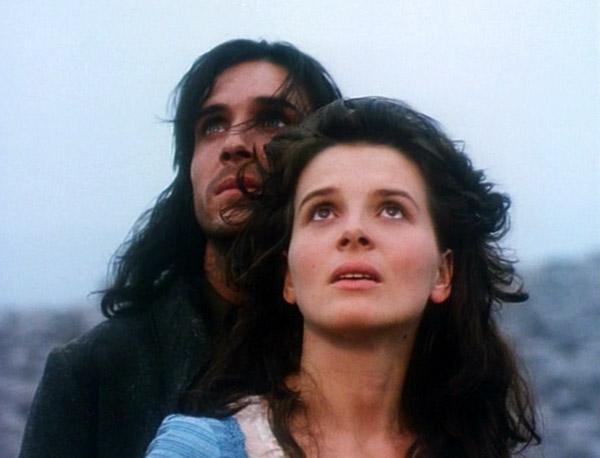
1. Wuthering Heights film 1992 starring Juliette Binoche (Catherine Earnshaw), Ralph Fiennes (Heathcliff)  with Jeremy Northam (Hindley Earnshaw)


2. Wuthering Heights Tv movie 1998 starring Orla Brady and  Robert Cavanagh with Matthew MacFadyen and Sarah Smart


3. Masterpiece Classic 2009 two-part series WUTHERING HEIGHTS with Tom Hardy, Charlotte Riley, Andrew Lincoln

4. SPARKHOUSE, Sally Wainwright ‘s BBC drama (2003), inspired to Emily Bronte’s Wuthering Heights  starring Sarah Smart, Joe McFadden and Richard Armitage


It has been a real marathon, full of passion and fury, tragedy and romance. This is one of the stories I’ve loved reading the most and which most move me to tears each time.
I first thought I could have used this post as one of the entries for my PERIOD DRAMA CHALLENGE  in the section VICTORIAN MIST but then I decided this story is absolutely non-Victorian, in spite of the date of its publication. It is Romantic in its mood; it has  a Byronic hero as its male protagonist and  a totally atypical female protagonist, too wild and passionate, too free and self-determined to embody the Victorian "angel of the hearth". Wuthering Heights is terribly modern in its originality. Impossible to label it  in a definite genre. What I am sure of  is that it is not Victorian.

WUTHERING HEIGHTS 1992

The most grey and bleak of the three adaptations I saw. Quite accurately based on the original text, it starts with a female figure wandering on the moors and revisiting the story she has heard about and decided to write: Catherine’s and Heathcliff’s tragic love story. It’s the first WUTHERING HEIGHTS I saw and the one I’m more affectionate to. Some details are given for granted but those who well know the story don’t need them to catch the dramaticity and beauty of these beloved characters and of their doomed lives. Ralph Fiennes and Juliette Binoche are absolutely convincing.


WUTHERING HEIGHTS TV movie 1998


Not so different in its structure from the 1992 film, some scenes are pretty similar. Still very near to the original text. Not exceptionally good. I don’t particularly like the two actors starring as the two unfortunate lovers. It has received much interest later on, after Pride and Prejudice 2005 was released, when a huge number of new Darcy’s fans started looking for more Matthew Macfadyen’s work. He is, in fact, in this movie as handsome Hareton, Hindley Earnshaw ’s son.


WUTHERING HEIGHTS- Masterpiece Classic 2009

Of course the script writers had to adapt this story for modern American and European modern  audience and they changed a good deal of details though substantially the plot is the one we very well know. I appreciated the effort to popularize such a classic novel but I must admit I don’t think it was so necessary to add violence to already violent characters like Heathcliff or Hindley and neither to show what happened in a "marital bed" (Shakespeare?) at night in those years, too. I loved the costumes and the locations of this Masterpiece Classic version.  (CLICK to see a BEHIND THE SCENES VIDEO)

SPARKHOUSE 2003

Just "inspired" to Wuthering Heights, SPARKHOUSE tells the story of contemporary teenagers. Carol lives at run-down Sparkhouse Farm with her drunken, abusive father, Richard (Alun Armstrong), and younger sister, Lisa. Across the valley live the middle-class Lawtons - Andrew, and his parents Paul and Kate. Carol and Andrew have been inseparable since childhood. At the beginning of the drama, they are 18 and passionately in love, a love that is raw, urgent and powerful. Carol is feisty and reckless, a young woman who is mistrusted and disliked by Andrew's parents who try to keep them apart. The only place they can be together is a ruined farmhouse up on the moors.

John Standring (Richard Armitage) works at Sparkhouse Farm. Loyal, hard-working, and painfully shy, he loves Carol. At first only a peripheral character, he gradually moves towards the centre of the drama.
The story covers approximately 5 years, and follows Carol and Andrew's attempts to be together in spite of numerous obstacles.

Just a curiosity, Sarah Smart interpreted Catherine Linton in Wuthering Heights 1998 and in Sparkhouse is, instead, the female protagonist, Heathcliff 's counterpart in this modern drama.

(Sarah as Cathy Jr in 1998)

(Sarah as Carol in 2003)

UNFORGETTABLE QUOTES (from 1998 adaptation) AND SCENES (from 1992 film)

1. Catherine is talking about her intention to accept Edgar Linton's marriage proposal to Nellie, her old faithful maid servant:

“If Heathcliff and I married we should be beggars. Whereas if I marry Linton, I can aid Heathcliff to rise and place him out of my brother’s power.”


“That’s a terrible reason for marrying Linton”


“It’s the best reason. I do love Edgar. But my love for him is like …is like the foliage in the woods. Time will change it. But my love for Heathcliff is like the eternal rocks beneath. Nellie, I am Heathcliff. He is always, always in my mind. Not as a pleasure, any more than I am a pleasure to myself, but as my own being.”

2. Catherine is dying and asks Heathcliff forgiveness for marrying Linton . He answers:


“I forgive what you’ve done to me. I love my murderer. But yours…How can I?”

3. After Catherine’s death, Heathcliff is desperate and shouts:

“I pray one prayer. I repeat till my toungue stiffens. Catherine Earnshaw may you not rest as long as I am living. Haunt me! Take any form, drive me mad! Only do not leave me in this abyss where I cannot find you. I cannot live without my life. I cannot live without my soul”.

YES !!! I KNOW IT IS TERRIBLY SAD. BUT I LOVE CRYING ON THESE EXTREMELY MOVING PASSIONATE SCENES. AM I THE ONLY ONE?

P.S. I have - but did not want to re-watch - an Italian  adaptation of Wuthering Heights (RAI 2004).


Can you imagine why? Too many changes, too many cuts. It's a total re-invention of the story as it happened with the latest Italian DAVID COPPERFIELD. Fortunately, I can watch movies and drama coming from Britain. They still seem to respect their classics. What about the new EMMA? Have you seen the first episode?