15/01/2011

DOWNTON ABBEY - YOU CAN'T MISS IT!


I've heard few dismissing comments like "it is not ITV Upstairs, Downstairs  nor Gosford Park and neither an Austen adaptation" (The last claim puzzled me a bit) . I've read  that it is full of clichés and nothing original. But now that I HAVE SEEN IT,  though partly agreeing with the previous statements,  may I say  that this  is a  really pleasurable drama, the wittiest and most intriguing I've recently watched? It made me so eager to see what happened next,  episode after episode. I very much enjoyed watching the 7 episodes,  it was  some time  since something I saw made me so enthusiastic. DOWNTON ABBEY is a must see for period drama lovers. It was broadcast on British ITV 1 in October/November 2010, it is being aired on US PBS Masterpiece Classic at the moment, but it can also be bought as a DVD  ( HERE  or HERE ). Second series coming in 2011. I can't wait! And, again, if you love period drama, you can't miss it!
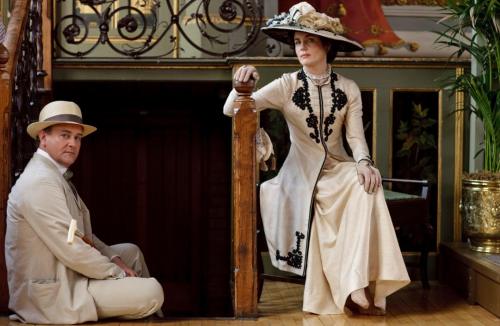
The story begins in April 1912 when the heir to the title of Earl of Grantham, long time inhabitants of Downton Abbey, perishes on the 'Titanic'. The benevolent current Earl (Hugh Bonneville) has three daughters, Mary, Edith and Sybil,  but the property is entailed and can be inherited only by a male heir. This P&P-like beginning shows the Crawley family at risk of losing their richness and their privileged rank. (If you want to understand properly the complex legal question  on which the fate of the protagonists depend, read this absolutely interesting and enlightening post at Austenprose : Downton Abbey Entailed? Understanding the Complicated Legal Issues in the new Masterpiece Classic Series).

The Crawleys of Downton are going to lose not only their grand manor house but the Countess of Grantham's (Elizabeth MacGovern)  huge patrimony. She is,  in fact , a very wealthy American heiress the Earl had married for convenience: her money had been indispensable to manage his wide estate. However, now, they love and respect each other deeply, though their married life, as in many other cases, had started more as a business agreement. This is what Mary, their eldest daughter, was supposed to do, too. A marriage of  convenience with the younger  heir  of Downton, now drowned with his father in the Titanic tragedy. What now?
There is only one proper solution: to marry their daughters to someone rich, especially,  her, Mary. And who's better candidate than the new heir of Downton Abbey, Matthew Crawley (Dan Stevens) , a distant cousin and a lawyer? Distant he is, in every sense, from the Crawleys living at Downton Abbey. He has always worked, he's sensitive but very practical-minded, intelligent and stubbornly modern, he refuses the aristocracy's stiff old manners, their formality,  and  hates the idea of becoming one of them, one of the privileged. He is a self-made man.

However, he and his mother move in from Manchester and starts being interested in the estate and its inhabitants. Matthew  goes on with his job and starts a friendly relationship with Lord Grantham. His mother volunteers in the local hospital and competes with Lady Violet (Maggie Smith), the Earl's mother, on many an occasion. Matthew falls in love with  Mary at first sight, but she doesn't like him at all. Above all , he represents what she doesn't want,  a marriage of convenience, what she doesn't accept, to sacrifice her freedom for the future of her family. So, you see, again something very P&P-like : first impressions!

The batallion of servants living downstairs and running the house, cleaning the place, taking care of the family offer other gripping plots which are interwoven with those involving the ones living upstairs.


 I loved the characters downstairs and their stories. Mr Bates's (Brendan Coyle) mysterious past and his newly-born, still timid, relationship with kind Anna (Joanne Froggatt); Mr  Carson's (Jim Carter) generous and authoritative managing the staff and connecting the upstairs to the downstairs world; Mrs Hughes (Phyllis Logan) discreet and efficient presence as well as her unexpected past romance; the envious, ambitious and wicked pair , Miss O'Brien  (Siobhan Finneran ) and Thomas (Rob James-Collier),  and their plots to hurt whom they don't like; then Mrs Patmore's (Leslie Nicol) , the cook,  story ,  which is sad and funny at the same time;
Gwen 's dream (Rose Leslie) of improving her education who is  looking for a new position as a secretary with the secret sympathy and help of one of the young ladies of the house, Sybil; William Mason (Thomas Howes), the second footman having a crush on Daisy (Sophie McShera),the scullery maid, who is instead in love with Thomas,  the first footman, she has kind of idolized without realising his real nature; finally  the chauffeur,Tom Branson (Allen Leech) who introduces Sybil Crawley, the Earl's younger daughter's,  to his own socialist ideals .

All these incredible stories remain open to new developments. The series ends  with a cliffhanger: England is at war with Germany,  the First World War has broken out.

The location.  Highclere Castle  , in Hampshire,  is a stunningly majestic country residence in the Elizabethan style.   (Read about it and visit the official site) It has been already used as a location for films and TV series: the saloon appeared in the film The Four Feathers starring Heath Ledger;  the exterior appeared as Lord Graves's house in the film King Ralph; it was Totleigh Towers, in the TV version of Jeeves and Wooster. Shots from both the interior and exterior are used as the imposing Mistlethwaite Manor in the 1987 version of The Secret Garden.

If you live in the US and missed the first episode, PBS will be making each episode available for a few weeks after its initial airing.  Downton Abbey is available for online viewing from  January 10 – February 22, 2011.

11/01/2011

AFTER LONDON, ROME!

I know, I  live at one-hour-drive distance from Rome. What's so special in being there, then? To me it is very special. Each time. And each time I discover more. Each time I realize I have still so much to learn .
I love being in Rome as a tourist (because more often it happens I'm there on errands which are job related)  and it has happened again in these latest days, thanks to my very special friend, K./V . who lives  there and hosts me each time I need a brief escape from ... my hermitage in the mountains.
I stayed there for a couple of days and we had a "bellyfull of art, sightseeing, wandering about the centre alleys and the picturesque landmarks, museums and exhibitions. Do you want to have a look at some of my  photos? Not work of arts,  but my own shots of breathtaking emotions.

ST PETER'S FROM CASTEL SANT' ANGELO 


The Mole Adriana, now called Castel Sant'Angelo, was originally built between 123 and 139 AD as the monumental grave of the Roman Emperor Adrianoand was used as a tomb by the imperial families up until the death of the Emperor Caracalla (217 AD). From what remains it is possilbe to imagine the original aspect of the "Mole", which became, later on, a  true fortress. The name Castel Sant'Angelo dates back to the late 6th century when under Pope Gregory the Great it was renamed because of the legendary miracolous apparition of the Archangel atop the Mausoleum, putting an end to the terrible epidemy of plague.

In 1527 Rome was invaded and occupied by troops led by Charles V (Sack of Rome) and, on that occasion, Pope Clement VII fled in safetyf, from the Vatican to the fortress, through the famous "Passetto", a passageway which starts from Saint Mark's bastion and runs on top of the wall that encircles the Vatican). Castel Sant'Angelo has been used as one of the impressive locations in  Dan Brown 's novel "Angels and Demons" as well as in  the movie based on it, but it was also one of the settings of Tosca by Giacomo Puccini. By the way, I saw all the settings of Tosca in my Roman errands these days: The Church of Sant'Andrea della Valle (act 1), Palazzo Farnese (act 2) and, of course, Castel Sant'Angelo (act 3) where Cavaradossi, imprisoned by Scarpia and overwhelmed by memories of Tosca,  sings "E lucevan le stelle".  

Can you see? Once in Rome you can't avoid a bellyfull of art! But thinking of more profane bellyfulls, I ate delicious food, too. We had lunch in a  famous trattoria near Via del Corso and,  at night, K./V. prepared  a very  exotic meal just for me, one of  Jamie Olivier's recipes, cous-cous and salmon. Have you ever heard about it? Maybe. Ehm... anyhow, it was tasty! It was my first try but ... I want to make it myself. soon It is rapid and delicious.

Among my firsts, I went walking along Via Margutta for the first time: iti s a small street looking southward toward The Spanish Steps  which in the 1950s, after the film Roman Holiday ,  became an exclusive road, and a residence of many famous people, like film director Federico Fellini and which is now a place with many art galleries and fashionable restaurants.  I visited Galleria Borghese for the first time, which I had longed to see for so long and never had been able to before, and which hosts one of the most stunning collections of the world (have a look at the link!) and, only until 13th February, an exhibition of Lucas Cranach's works, Cranach, The Other Renaissance

Finally I saw the Trevi Fountain from the inside for the first time, have you ever tried? It's curious to see the always crowded square and the fountain from the windows at its back. As evocative as observing someone you know very well from a hidden corner and a completely new perspective. Curious, indeed.


That's all from my latest Roman Holiday!
Till next one, hope it'll be soon. Thanks, V. xxx MG


07/01/2011

WHAT WILL FRIDAY BE LIKE?


Ehm...Let me go straight out with it. I've thought about it a lot, I've talked about it a lot and, finally, I  decided I must follow my heart!
It's one of those days, you know, one of those big days. Are you wondering what kind of big days? Those in which you make big decisions. 
Ah!  I love Geraldine and Harry J. Kennedy! Will they ever be back on screen together? Fingers crossed, stop kidding and ... to the point!
 
 Don't look at me like that  ... I won't change my mind. (Lord, give me strength!)

I'm terribly sad at giving this announcement but I've actually been thinking about it much.
It's time to change. And,  honestly, not only that. This is my post n. 97 tagged Richard Armitage.  I posted RA Fridays from January 1st till December 31st in 2010. But it has really become hard for me,  it has started to give me terrible anxiety. What? The idea of Friday approaching and me having nothing to say about RA , it has started to give me troubles. Mind you, I've got plenty to say about Richard, but nothing you haven't  already heard or  read thousands of times. So I made up my mind:  it's been very satisfying, rewarding, exciting, stimulating but only till I had plenty of new things to write about. Now, it's time to change. So, sadly to admit it, I have to say good-bye to our RA Fridays and start thinking of something new.

 Don't stare at me like that! I won't neglect you, Richard,  promise!

Don't worry,  my friends. I won't resist long without posting somehing about RA ...  only it'll be out  of a weekly or periodical event, just any time I feel like doing it. Well, think that...  I could even post about him more frequently now! I hope to be overwhelmed by new things to write about. It'll be soon, knowing the man. And thinking of him right now ... I hope he's having or going to have a great time in New Zealand training for The Hobbit. Most difficult tasks for him? To bear wearing a fake beard (and a wig too? I can't imagine what  torture it can be!) and try to look like a dwarf . Yes, I know, CGI...but he will try to imagine he really is one to fully fit the role. Tough job for a giant!

 At last, he smiles!

Don't be sad! Stay tuned. Plenty of RA on Fly High very soon.
Have an incredible weekend. MG

05/01/2011

AT THE OLD VIC: A FLEA IN HER EAR. MEET ONE OF THE YOUNG PROTAGONISTS ON STAGE: GREG BALDOCK

As I told in one of my latest posts from London, I was at the Old Vic on 29th December to see  A Flea in Her Ear by G. Feydeau. I was so excited to be there on my own! I was quite proud of myself  for the first time in that prestigious theatre and going to attend a performance of two actors I had admired in  some of my beloved costume dramas: Tom Hollander,  I had seen in Wives and Daughters, Cambridge Spies and, of course, Pride and Prejudice 2005 , as well as Lisa Dillon,  who was one of the lovely protagonists in Cranford. But my enthusiasm was soon cooled down by the announcement of Mr Hollander's absence for a sudden indisposition that night.
If the start was so disappointing the end of it was total enthusiasm. If the success of a farce is based on how much the audience laugh, that performance of Feydeau's play was definitely and hugely successful. I couldn't stop laughing and neither the rest of of the audience! 


The pace of the performance was really  fast,  the cast brilliant, the rythm and timing almost perfect: each  door was slammed just at the right moment, each gag and paradoxical situation were manifactured with convincing energy, the sequence of misunderstandings were escalatingly hilarious, though stereotypical the characters were all extremely involving. My favourite ones were the jealous manic Carlos Homenides de Histangua, interpreted by volcanic John Marquez; Camille, the protagonist's nephew, whose speech impediment (being unable to pronounce consonants) leads people to lose their patience with him , played by  a sparkling blond talent, Freddie Fox; and,  last but not least, the young excellent understudy who substituted Mr Hollander  and carried out the hard task so stunningly well that I forgot my initial disappointment, Greg Baldock, who was  both Victor Immanuel Chandebise and his look-alike drunken hotel porter, Poche. Young Mr Baldock substituted a great name with great talent,  so I wanted to congratulate him but first I had  to get to know his name, which I hadn't caught during the announcement of Mr Hollander's substitution. Now I know his name and even something more about him, since he was so kind to accept to answer some questions of mine about himself, that evening, his career and dreams. Yes, I interviewed him!


MG: Hi Greg! Glad to make your acquaintance, though only via the Net.  First of all, I must congratulate you for your performance as Chandebise/Poche in  “A Flea in Her Ear”.  I was there at the Old Vic few days ago, in the audience, and I was one of those who booed a little  when Mr Hollander’s sudden indisposition was announced. Honestly,  I was disappointed. Then, you appeared on stage after some minutes from the beginning and I thought “O my God, he’s so young!  It won’t work”. Well, after  a while  I had completely forgotten you were the understudy.  You were so self-confident and … brilliant! I enjoyed myself so much.  I couldn’t stop laughing, I think I’ve never laughed so much at the theatre. 
Now, it’s your turn, Greg. Can you describe your emotions on that evening? Was it your first great occasion or had you already worked on an important stage like the Old Vic?
GREG: Firstly, thank you for your compliments. This is my first, as I only graduated from Rose Bruford College Of Theatre And Performance in September 2010, so this is all very much exciting and amazing work for me to have achieved in such a short space of time. The emotions for that evening were a very heavy combination of adrenaline and an incredible amount of reaction to the great performers on stage. 
  
MG: How did you keep yourself ready to substitute Mr Hollander any time it was needed?
GREG: Really you just need to be on the ball all the time. As an understudy, I find it very important to keep watching the play every single night, and constantly make sure I’m updated with any new moves or changes to the structure of the performance. The real trick is to be off script when the play goes up in the preview nights, and then it’s just a roll of the dice if you have to go on at any point.

MG: The double role of Chandebise & Poche must be extremely exhausting both mentally and physically. You were very good at giving a different  posture, stride, speech to the two characters.  Was that the most difficult aspect of this performance?
GREG: Not at all, the script informs you of the characters with their different language rhythms and your physicality sort of develops from their speech patterns. I would actually say for me that the most difficult part of this job is to stay energized for the entire performance. I am a trained beach lifeguard, and that requires 16 lengths in under 8 minutes and a length and a half non-stop underwater, amongst other skills. In comparison, performing on stage for the most of the 2 hours in a farce is by far a lot more exhausting. I am usually drinking a pint of water between scenes, a banana before the play starts and one at the interval, and a whole host of multivitamins and isotonics wherever I squeeze them in. Because of cramping in my thighs, I’m also licking salt from the back of my hand just to get some into my system because I sweat it all out. 
  
MG: What is your relationship with the rest of the cast?
GREG: Pretty good actually. They are by the far best cast I have ever worked with and they are all very very supportive, not to mention utterly professional to a standard I have never seen before.
 
            MG:  In Feydeau ‘s farces the secret  of success is … ?
GREG: Tempo, tempo, tempo. You must never drop the rhythm. It’s  not quite like an English comedy, where you can afford to wait for laughs, but, instead, there is a ‘pressure cooker’ idea which builds and builds and builds, which is why by the time it gets to the third act, the speed is like lightning. 
  
      MG:  Have you substituted Mr Hollander again after 29th December?
GREG: Yes. In fact I substituted him on Tuesday, on the night before. I will be covering him all the way up to Saturday 8th January. Apparently he will be ready to go again on the following Monday.

      MG:  Now, Greg, can you tell us briefly something about yourself?
GREG: I’m only 23, I trained for 3 years at Rose Bruford College Of Theatre And Performance, and I’m originally from Merseyside. I’m a big fan of poetry, movies and music from the 1980s, and playing the electric bass guitar.

      MG: As a promising young actor I’ll keep an eye on you and your career. Sooner or later I’m sure I’ll see you on one of my favourite BBC dramas or in a new period movie. Why period, do you wonder? Because it’s my favourite genre. LOL!  However, would you like to work on TV or would you rather go on with  the theatre?
GREG: Hmmm. Well, I would like to do some more TV and possibly film, as I actually find them a little easier. If doing theatre is like running a marathon, then I would say TV is a bit more like sprinting. It’s great because you can sort of condense all your work into one brief moment. However , theatre is your art really, and it always gives an actor the opportunity to explore, play and constantly make new discoveries.

      MG:  What is your greatest dream as an actor?
GREG: For me? I’m pretty realistic, so for me, I would love to play a long term character on a long-running drama series for television. A lot of American television drama series can afford seasons with lots of hour long episodes. Either that, or a couple of stints at the Royal Court would do me just fine.

      MG: What’s next? I mean, after finishing at the Old Vic?
GREG: I have no idea. My agent is inviting as many casting directors as possible to the show this week, so I will have to see what crops up. I imagine I will get some understudy offers, but hopefully there will be a  chance to get to grips with a character of my very own.

MG: Good Luck, Greg, for anything in your private and professional life. Thanks for finding the time to answer my questions. 
GREG: Thank you!


04/01/2011

LETTERS CAN TELL WONDERFUL STORIES

1. 84, CHARING CROSS ROAD by HELEN HANFF (1970) - FROM THE CULT OF BOOKS TO A CULT BOOK.
 For one who loves books,collecting  and reading them, as well as classic English literature this is a must read. It has come on my way only now (published 1970) thanks to a friend who knows me very well.  84, Charing Cross Road was also made into a film starring Anne Bancroft and Anthony Hopkins in 1987.
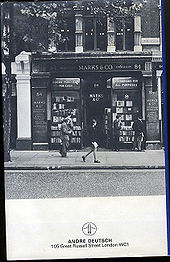
Since I love books about books, I greatly appreciated  this little epistolary novel based on the real exchange between the authoress Helene Hanff , living in New York, and the staff at Marks &Co. in London , from which she gets precious antique volumes at very little price. 
She became intimately involved in the lives of the shop's staff, sending them food parcels during England's post-war shortages and sharing with them details of her life in Manhattan. They go on exchanging letters from 1949 to 1969.

Due to financial difficulties and an aversion to travel, she put off visiting her English friends until too late; Doel died in December 1968  and the bookshop eventually closed. Hanff did finally visit Charing Cross Road and the empty but still standing shop in the summer of 1971, a trip recorded in her 1973 book The Duchess of Bloomsbury Street.
I love the following short excerpt which demonstrates Helene's love for the object "book" in itself, especially if it has a story. She's not interested in its value in money, but in its value in life.
"I wish you hadn't been so over-corteous about putting the inscription on a card instead of a flyleaf.It's the bookseller coming out in you all, you were afraid you'd decrease its value. You would have increased it for the present owner. (And possibly for the future owner. I love inscriptions of flyleaves and notes in margins, I like the comradely sense of turning pages someone else turned, and reading passages someone long gone has called my attention to." (p.27)

2. THE GUERNSEY LITERARY AND POTATO PEEL PIE SOCIETY by MARY ANN SHAFFER & ANNE BARROWS (2008)

"Perhaps there is some secret sort of homing instinct in books that brings them to their perfect readers."

A sentence from this novel which drew my attention. I was stunned when I read it,  because this book has found home on my shelves in a very fortuitous way,  it has found me, "its perfect reader".  My friends and I found it in a basket of second - hand books outside the little church in Turville, the tiny country village we visited in Buckinghamshire in November. It was not me the one who took it, though. My friend V.  did it and started reading it on the flight back home. She  finished it in a few days but she said she didn't like it very much . So she wanted to pass it to me. She thought I might like it.  Thanks, V.!  Much appreciated. It's been a great pleasure to read it and now it'll be an even greater one  to host it on my shelves.

Now to my review.

Can letters tell a story so effectively that you are amused,  even laugh, sympathize with the feelings described, are moved to tears, get little by little deeply involved  into the characters' lives? Yes, if you read this book. It had never happened to me with an epistolary novel. But this one is unique in several ways.
It has so many features I'm fond of :  WWII  as the historical background, the UK (Guernsey island, in the Channel,  and London as the main settings ) , stories of love and friendship, dramatic events, funny anecdotes, love for books, its dealing with the importance of reading as well as writing. It was impossible for me not to love it.
It is a novel with very positive messages in which the grimness of war-time existence is enlightened by the courage, matter-of-factnesss and humor of the protagonists. They are all extraordinarily bizarre and humane. The heroine is author Juliet Ashton. She is  immediately charmed by the stories that the numerous members of The Guernsey Literary and Potato Peel Pie Society start writing to her, so charmed that she cannot resist. She must meet them, she must go there. She leaves everything she has in London to join them in Guernsey. She is successful as a journalist and as a writer but is experiencing extreme discontent. Maybe she's only now surrendering to the great shocks the war had  brought to her. She had her house  destroyed during the Nazis' heavy bombing of London and is still alive only by chance.  She needs inspiration for a new book but finds much more in Guernsey. She finds home and the love she,  an orphan, has always longed for. She finds the answers to her most inner questions and learns much from all her new friends: Dawsey, Isola, Amelia, Eben. The soul of the reading  society during the German Occupation of the island was Elizabeth McKenna, the only absent member, the only one Juliet won't succeed in meeting. She was the soul of the reading group and is the heart of this book. Juliet owes much to Elizabeth in the end: a new great book to publish and a new life full of love and friendship.
One of the most rewarding  readings in the latest years. I felt lucky and happy to share the appreciation of these pages with so many enthusiastic fans.


02/01/2011

SEEN IN LONDON - BBC 1 UPSTAIRS, DOWNSTAIRS


I know Upstairs, Downstairs  was one of the biggest TV hits of the 1970s, both with British audiences and around the world (not in Italy, it wasn't on Italian TV). Unfortunately, I have never seen it, not one episode, so what I cannot do here is a comparison between the original and this new re-make,  broadcast on BBC1 on 26-27-28  December, which I was lucky enough to watch on TV while I was  in London.
I liked it much. It's good period drama with a brilliant cast and great taste for costumes, locations, period details.
What I cannot do either is to answer the question "Is it as good as/better/worse than the incredibly successful Downtown Abbey?" , since I haven't seen the latter yet. But I'm going to do it soon, promise.
So I can only focus my review on BBC1 UPSTAIRS DOWNSTAIRS 2010.
I read that the ITV series showed life above and below stairs at a wealthy home in Edwardian London, complete with gossip, intrigue and affairs of the heart and this is what happens in the new series too.


I've also heard that Jean Marsh played housemaid Rose and also co-created the series. She was among the ones downstairst also this time. First, she said in an interview, she had reservations about both her character's and the programme's return. Then her doubts vanished. 
The new show picks up the action precisely  in 1936 with another family moving into the Bellamy family's old house at 165 Eaton Place.
The wreath above the mantelpiece is full of dust. The chandelier is covered with cobwebs. Then a key turns in the lock - and a handsome millionaire walks in, with the woman he loves in his arms...


Sir Hallam Holland enters the iconic townhouse with his wife, Lady Agnes. With the help of former maid Rose, they launch a whole new era for the sumptuous London residence. Lady Agnes remarks: “This house is going to see such life!”
But storm clouds are gathering in Europe, and servants are no longer biddable and cheap. The Hollands’ first year at Eaton Place does not unfold as either Lady Agnes or Rose anticipates.
The drama  sets intriguing domestic plots against a sweeping historical background. There may be two families living in 165 - one upstairs and one down - but their fates are intimately linked.

 
The cast is  full of familiar faces (see photo above
Back row (on stairs) L-R: Ivy Morris (Ellie Kendrick), Harry Spargo (Neil Jackson), Mr Pritchard (Adrian Scarborough) and Rose Buck (Jean Marsh)
Front row L-R: Maud, Lady Holland (Eileen Atkins), Lady Persie (Claire Foy), Johnny Proude (Nico Mirallegro), Mr Amanjit (Art Malik), Lady Agnes Holland (Keeley Hawes), Sir Hallam Holland (Ed Stoppard) and Mrs Thackeray (Anne Reid)

SIR HALLAM HOLLAND.  He appears to have everything. He has risen rapidly through the ranks of the Foreign Office, and has recently inherited not just 165 Eaton Place but a considerable fortune and a baronetcy. The events of 1936 will challenge and change him in ways he could not have foreseen. I like the journey of this character in the series very much.

LADY AGNES. The eldest daughter of the 12th Earl Towyn, she was reared in a very damp castle in Wales. Beautiful and aristocratic, she has never been well off. Despite financial hardship, and their failure to have children, her marriage to Sir Hallam has been happy and devoted. The sudden rush of new money thrills her, and she is determined to put her husband, and her home, at the heart of London high society.

LADY HALLAM. Maud, she is Sir Hallam’s mother, one of the women who helped to build the Raj. Newly widowed, she returns to England to write her memoirs, and  hopes to build a new relationship with her grown-up son. But thirty years of distance are not easily overcome, and there will be  heartache along the way. And secrets unveiled in the end.

LADY PERSEPHONE TOWYN. She  is the 20 year-old sister of Lady Agnes. She has been marooned in Wales due to lack of family funds - a situation Lady Agnes is delighted to reverse. But Lady Persie’s lack of education, and the stimulation of the London scene, make for a highly combustible mix. Especially when she starts a scandalous affair with one of the men downstairs and sympathising with the Fascists.


 ROSE BUCK. She was the upper house parlourmaid at Eaton Place for almost forty years. Since 1932 she has eked out a living running a domestic employment agency - but a twist of fate brings Lady Agnes to her door. Initially engaged purely to recruit the servants for the Hollands, Rose soon proves herself indispensible to the running of the house.

MR PRITCHARD. Warwick Pritchard is sleek, discreet and quite beautifully spoken. Teetotal and highly strung, his exacting façade conceals deep kindness and real integrity. As the downstairs family settles in, he gradually becomes the moral centre of the household - though he still has a few surprises up his sleeve.
MRS THACKERAY. Clarice Thackeray is a widow. Passionate about her work, she expects the highest standards of herself and others. She follows the workings of high society through the pages of the Tatler. Romantic and affectionate by nature, she is also nosey, judgemental and a monumental snob.

MR AMNJIT. Educated, gentle, and imposing, Amanjit Singh comes to Eaton Place as secretary to Maud, Lady Holland. Having been in her service in India for many years, he is devoted to her welfare. His relationship with German/Jewish Rachel is touching.

RACHEL PERLMUTTER. She  is a German-Jewish refugee who comes to 165, as the new parlourmaid, in May 1936. Reserved and sophisticated, Rachel knows little about basic household chores, but is determined to make the best of her circumstances.

HARRY SPARGO. Good-looking and rather arrogant,  Harry Spargo enjoys his position with Hollands, but resents the social system that keeps him there. He enjoys a cautious camaraderie with Sir Hallam, but this is put to the test by the events of 1936.

IVY MORRIS. Just 15 years-old and  orphaned, she  is spirited, wilful,  likes red nail varnish and singing in the bath. Ivy would never willingly risk her newfound security at 165 but her hunger for love leads her, and others, into danger.

JOHNNY PROUDE. Aged 16,  he  launches a career in domestic service in an effort to escape a life spent down the pit. Charming and hard-working, he is popular with the other servants - especially Ivy - but comes to 165 with a troubling secret that, once revealed, will shatter the whole household.


The sets are exquisite, especially the  ones for interior scenes. Exterior scenes – such as the spectacular recreation of the Cable Street riots were relatively few but always  essential to the storyline. I agree with Heidi Thomas, writer and executive producer when she says that
"There is also a very strong message of equality in Upstairs Downstairs,which is often overlooked. Because the drama treats both rich and poor with an even hand, it says to the viewer 'Whether you drip with jewels and are swathed in furs, or are wrapped in a pinny and scrub until you hands bleed, your story really, really matters'. It respects and celebrates every aspect of human experience, and that is a powerful thing".


You can still see the 3 episodes on BBC iPlayer,  if you live in the areas where the service is available.