13/12/2010

WHAT I'VE BEEN WATCHING - THE LAST STATION (2009)


"The greatest way to improve each other's lives is not through money, gifts, good advice, or even work, but through love. Every person's responsibility is to nurture love and bring it into this world,"
(Leo Tolstoy)


I've been looking forward to seeing this movie for a while now and finally saw it yesterday .I thoroughly enjoyed everything about it! 
Starring Helen Mirren as Sophia Tolstaya, Christopher Plummer as Count Leo Tolstoy,  James MacAvoy as Valentin Bulgakov, Kerry Condon as Masha and Paul Giamatti as Vladimir Chertkov, THE LAST STATION (2009) is a film directed Michael Hoffman based on Jay Parini's novel telling about the last year in Tolstoy's life.

It is indeed a story full of strong feelings and emotions, conveyed by extraordinarily good performances by all the leading actors. They were all awesome, touching, brilliant.
The events take place in the large country estate of Leo Tolstoy who in 1910 is a wise but troubled old man who is trying to take stock of his life and his work, but whose celebrity status gives him no privacy or peace. The story explores the many shades of love in his life and in the lives of those around him. His ideal of nurturing love is a noble one but hard to handle in the world of competition, jealousy, fixed ideas, and rigid ideology.
 
In 1910 Count Tolstoy was under considerable pressure from his Tolstoyan followers to reject his wealth and surrender the copyright of his works. Tolstoy’s aristocratic wife Sofya was deeply opposed to the Tolstoyans whom she believed were pressuring Tolstoy to remove her from his will. Christopher Plummer as Tolstoy and Helen Mirren as Sofya were both nominated for acting Oscars and they do a fine job at conveying a tender love that persists despite huge political and ideological differences. Paul Giamatti and James McAvoy are also terrific as two Tolstoyans with McAvoy playing the film’s lead character Valentin Bulgakov, Tolstoy’s new secretary whose loyalties are torn between ideals and love.

Valentin, played fetchingly by James McAvoy, is a bewildered witness to the crisis in the stormy relationship between Tolstoy and his wife, which results in Tolstoy fleeing Sofya and his estate, only to die at a lonely railway station many miles away, with the world's media (such as it was in 1910) looking on. Unfortunately Valentin, based on a real person, is not only green but rather ineffectual and he is in the story as a witness rather than as an actor. One of the features of Tolstoyans was that they all seemed to have kept diaries and these provided Parini with most of his material. You can see why Hoffman made Valentin the central character. He is seducted by the lovely Tolstoyan Masha (Kerry Condon) in contradiction to Tolstoyan-mandated chastity but it is the relationship between Leo (Lev) and Sofya that provides the real drama here, and the final scenes between them are genuinely moving.
And moved I was. To tears.


12/12/2010

OUTLANDER BY DIANA GABALDON - A CONTROVERSIAL READING


From the book cover : The year is 1945. Claire Randall, a former combat nurse, is back from the war and reunited with her husband on a second honeymoon--when she walks through a standing stone in one of the ancient stone circles that dot the British Isles.  Suddenly she is a Sassenach--an "outlander"--in a Scotland torn by war and raiding Highland clans in the year of Our Lord...1743.
Hurled back in time by forces she cannot understand, Claire is catapulted into intrigues and dangers that may threaten her life...and shatter her heart. For here she meets James Fraser, a gallant young Scots warrior, and becomes a woman torn between fidelity and desire...and between two vastly different men in two irreconcilable lives.

First in a series of books that combines time travel, history, sexy romance, and a bit of genealogy, "Outlander," by Diana Gabaldon, takes the heroine,  Claire Randall,  back in time 200 years,  to 18th century Scotland. Precisely to 1743 on the verge of the tragic Jacobite uprisings  - the time period of her husband's scandalous ancestor, Captain John Randall. Thus begins a story full of adventure, history and romance as Claire tries to reconcile her mysterious appearance in 18th century Scotland with her life and husband in the 20th century. Actually, she doesn’t seem to miss her past (or future?) so much. She is,  in fact,  totally caught in the web of her new dangerous, adventurous, intriguing life,  and, especially, bewildered by her new charming partner, Jamie Fraser, and is rarely nostalgic.
This is it. At last, I've read it. After hearing  friends and acquaintances talk about lovely Jamie, I’ve finally made his acquaintance. So? Do I like him? Impossible not to. Though I think he is  too good to be true. Too young, too handsome, too naive, too patient, too impatient, too kind, too strong,  too  ...  fictional! That is what he is, in fact.
On a shallow note,  his red hair. Nothing against fair haired people, of course. Only I went on figuring him as tall, dark and handsome. Something like this… 

Not at all like Jamie, I know

or this… 

Even less than the one before, you're right
and when Ms Gabaldon – who had any right to do it, since Jamie is her creature – reminded me of his long red-gold hair I was so annoyed! Couldn’t she just let me dream my own Jamie? Which I did,  against all the details given.Only I found him always too perfect to be my hero.
Jokes apart, I actually appreciated this first instalment of the saga which sold millions all over the world. Just ask my friends. I read most of it  while in London at the end of November and any occasion was good to open my "Outlander" copy with a smile printed on my face: in the tube, on the train, on the plane, waiting for the others finishing shopping at the stores, sitting  and freezing on a bench in a park, at night in bed though exhausted. Once you start, you can’t stop, you want to go on and to get more . This novel  is everything a good page turner must be: intriguing and well written. 
Diana Gabaldon
Smart Ms Gabaldon  obtained a successful blend skillfully mingling the most popular features of historical fiction for female audience. And it seems she goes on as successfully as she started with Jamie and Claire’s adventures after many years and a huge number of copies sold. The story has got to its 7th instalment!
 After studying and teaching the Jacobite rebellion leafing through my history books or Sir Walter Scott’s “Waverley” (1814), reading "Outlander" was actually great fun..It was like  watching those familiar tragic   historical facts with a much lighter touch but  more involved/ing  point of view.

I ‘ve told you something about the hero. Now, the heroine… I couldn’t actually sympathize with Claire Randall in  her experiences in the Highlands. She seemed rather insensitive at times, often selfish and sometimes it is like she is watching   and evaluating  things  in such a detached way! I can’t see her as very passionate either,  though she is brave. She’s more matter-of-fact and  more pragmatic than romantic, often too impulsive and  so very little sensible. When she looks smart, it is only because she is helped by her “outlander” experience and just seems cunning.  She is even annoying when her impulsiveness leads her to get stuck in troubles and patient Jamie must be there, always ready to rescue her at the cost of his life. I wondered and wondered :"Is this loyal, brave, fascinating, passionate hero what Claire deserves?"
In this story,  she has to face a choice, a difficult one, but I can’t feel any real pathos or sorrow. She incredibly rescues him from death in the end but , simply and bluntly,  I can’t like her very much.
Now, why can’t I? Aren’t women readers supposed to recognize themselves in heroines? Not always, in fact. I’ll try to itemize the several explanations I gave to myself:

1.    I can’t sympathize with her because I’m envious/jealous
2.    I can’t because I am so different from her,  hence I  would have made different choices all the time
3.    I can’t because the hero is so terrific that poor  "she"  is shadowed and reduced to a  great actor's stooge
4     All of the above

Maybe n. 4 is the answer.

Anyhow, very  little flaws but lots of highly entertaining moments as far as … the last 200 pages . Wentworth Prison first and  the Abbey in France in the end … There,  something changed. It was not only because of all  the pain and suffering described, neither for the scabrous details given in this section. There was something definitely different in these pages, so distant from the previous fluent narrative that everything  sounded  barely convincing,  as if everything happened forcibly so with my mind refusing to accept it as totally and utterly impossible.
Those pages must have puzzled more than one reader, since Ms Gabaldon herself tries to defend her choices  in a heartfelt  blogpost  in which she advocates herself and her creatures:  Jamie and the Rule of Three.

The last 200 hundred pages were the main reason for giving this highly entertaining best-seller only 4 stars out of 5.
I know I’m rather late to the party and that many of you have already read most or all of the saga, through thousands of pages, as far as “An Echo in the Bone” (the last novel released in the series) but would  you mind to share your thoughts with me?  It has been  a controversial reading but, honestly, not one which has  left me untouched or unimpressed.  

10/12/2010

RA FRIDAY - MOODY ME & BROODING MR THORNTON : WHAT ABOUT THE THIRD WISH FOR CHRISTMAS?

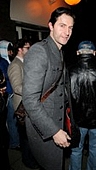
My mood these days? Festive, you say? Since Christmas is near?!? Not a bit. As usual at this time of the year I'm rather stressed (end of term) and melancholic. My mind is in fervent prayer that it passes soon with me unhurt. The older I grow the more ardently I wish I can skip Christmas and all the related duties. I can't explain why and when it started but here I am bluntly confessing  my awful sin with no sign of repentance or regret. What does RA with his sorrowful  piercing stare (above) have to do with that?  Mmm, actually, not much. Though, as soon as Spooks 9 finished , I started experiencing a sense of loss as if I was mourning someone. I reacted bravely and strongly at first, but once the initial shock vanished I started  feeling a terrible sense of void. The idea of waiting for months (many!) to see RA at work again and in something I'm not interested in  very much ( Captain America, The Hobbit) makes me incredibly sad (withdrawal symptoms?). Is this why I chose these bleak  images from North and South ep. 3? No, actually no. Truth is  my RA post today should focus on my latest trip to Hamsptead (London) to visit St John's. It is the church where they shot Mrs Hale's funeral and Fanny Thornton's wedding. You can see RA/JT sitting on the grey bench staring at Margaret on the left above and silly me smiling blissedly because I was sitting on the same bench ( below ).


 In my hands I've got our notes taken from Annette's site,  since we wanted to be sure we found the church and the right seat inside it of course! We immediately recognized the facade though the doors had been painted in red and entering it was impossible not to recognize the odd shape and colour of the benches. The light and colours were less stern than I had imagined , there was someone playing the organ   and the place was so peaceful.
From the TV series

From our London trip


 We spent some time inside trying to notice every little detail we could and then walked outside in the churchyard where we knew there was one of Jane Austen's aunts buried as well as  English Romantic painter John Constable. There was a stage in front of the altar, the parish drama club was going to stage "An Ideal Husband " by Oscar Wilde.

Mr Bell: "Can you see those ladies down there?
Do you think they are looking for you , Mr Thornton?"
"Who? Italian ladies? What are they doing here?"
"Oh! Miss Hale!
Could you save me from those Italian ladies, please?
Could you shield me as you did at Marlborough Mills?"

LOL! I needed to exorcize  my blue mood with a good laugh! Come on, silly me! It's true,  Christmas is coming and  I don't like most of the stuff connected to the upcoming  holiday time but ... I might .. ask Santa for a special gift!  A very special one!
No! No, no, no! What are you giggling at or  thinking of? No naughty wishes! I swear! Mine  is simple, plain and ... innocent. LOL!
Since I've read this lovely report of a magic night on Feigned Mischief blog,  I've started longing for seeing this  with my own eyes: " ... prancing on stage, lifting his long lithe legs effortlessly, swirling his lustrous thick jet black hair as if he was the star of a new Pantene male advert! Didn’t know RA can do comedy! He was hilarious! He then goes to Debbie and they start a dance routine that left the audience practically in stitches. I remember reading that he studied dance in LAMDA so this must be all second nature to him". 


This would be the perfect Christmas gift to me! I might even forget or bear the fact that it was  Christmas! Who might  have recorded those magic moments, “The 24 Hour Plays” at the Old Vic on 21 November?  Do you think the organizers at the theatre did any recording of the event? Let's start a campaign to ask them to distribute a DVD of the plays to raise money for charity. They said they got £121,395! What about getting more then by selling a DVD of the event? I was thinking of something like  the "Bring North and South to PBS" campaign. Are you ready? Can we have any chance to be satisfied? I'd give any sum to get a copy. What about you?
Suggestions for a perfect RA weekend:

1. Read the awesome Gisborne fan fiction at Mesmered's BlogThe Sheriff's Collector.  (I love it!)
2. Start thinking about a Christmas RA gift to ask from your friends ( The lovely man in person is too much, believe me! But dreams cost nothing... ) 
3. Find a way to support MG in the campaign to get a DVD of "The 24 Hours Plays". She needs help!
4. Look at the picture below from time to time, cuddle yourself a bit and try to forget troubles and pains. Grant yourself the sweetest daydreams!


Have a very lovely weekend, you all!


09/12/2010

LET'S CELEBRATE JANE AUSTEN ON HER BIRTHDAY - GREAT EVENT ON MY JANE AUSTEN BOOK CLUB!


Great celebration for Jane Austen's Birthday! Next Thursday December 16th,  I'm having a blog party with some  good Austenite friends and great gifts and giveaways for all our readers. You are all invited!!!

Read the details on My Jane Austen Book Club.

08/12/2010

WHAT I HAVE BEEN WATCHING - IL SANGUE E LA ROSA ( The Blood and the Rose)


I've been watching this 4-part Italian costume drama, "Il sangue e la rosa" (The Blood and the Rose, 2008). I can't say I'm fond of Italian TV drama, but I can't say I didn't like this series at all either. It was based on a good script, a good blend of comedy and drama set in 19th century Rome. Beautiful settings and costumes, intriguing plot full of the many traditional features of period drama. However, there was something definitely disturbing, something I remember I have already discussed on this blog while  reviewing other Italian TV series ( David Copperfield, Il Falco e la Colomba).


I can't bother the fact that often in Italy you can be "something" or "someone" even when you do not possess the indispensable knowledge, talent or competence . Is it the same in your country? Better I'll stop here, since I've always avoided serious reflections about the state of my country Fly High, especially because it is my escape from sad  reality. But this is what I  won't avoid saying  today: it seems that to be an actor or an actress in Italy you don't need to be  talented or at least decent at acting .

You can just be a popular face from "Big Brother" or other TV  reality shows, a very handsome bloke, a very gorgeous young woman... that is enough to be in a cast . "Il sangue e la rosa" stars  good  actors and actresses such as Giancarlo Giannini, Franco Nero, Virna Lisi , Franco Castellano, Martine Brochard but also several  good-looking "dummies" rather improbable as actors or actresses . Their elocution, the way they deliver their lines,  is often pathetic. Their facial and body language quite static.


 This lack of competence and talent is  something I just can't stand. Not only in the acting field,  but also and especially in crucial fields like politics, health care, education. I claim the right to have the right person in the right place.
This is not what I exactly wanted to write about, but this is what came to my mind reflecting on the bad acting of part of the cast . Fortunately  the  acting  standards of the other part were high. Pity is ... It is like mingling "il diavolo e l'acqua santa",  we usually say. It means "mingling the devil with holy water".
Anyhow, I got to the end of it ,6 hours, to see how the story developed and ended and it was amusing, intriguing end even gripping at times. If only those dummies had gone to drama school at least for some days in their lives! Watching the good actors and the dammies together was something  like zapping from a good period drama to the parents' recording of  students' school plays.

Ok. Sorry for being so blunt, I hate when I have to be that critical. And you will wonder why  I persist in watching Italian period drama if I'm well aware of what it is like... Because from time to time I've found something good and I've been happy and proud. Hope is hard to die.
But as I told you, the script was not that bad. Light, hilarious most of the time,  but also full of twists and turns. The plot is quite complicated but the main level of the narration focuses on the 3 protagonists. In fact, a triangle of friendship and love is at the heart of the story: in the small town of Cave (not far from ny own town) the charming young daughter of the host of the place, Isabella Malvolti (Isabella Orsini) spends her time between forbidden books and his only best friend, Rocco (Gabriel Garko) , a handsome young worker who has always been in love with her.

Rocco tends to be a rebellious leader, ready to risk his own life to defend the weak, he is restless and passionate. He will start getting in troubles with the law. Giulio Mancini (Mirko Petrini), instead, arrives at Cave with his mother Camilla (Martine Brochard). They are from a noble family but they have to hide themselves as outcasts since their respectively father/husband, Count Umberto Mancini (Franco Nero) , died as a "carbonaro" throwing leaflets stirring  to rebellion from the top of a  tower.
An indissoluble bond of friendship and love starts between Isabella, Rocco and Giulio:   the two young men  are loyal  friends to each other but both in love with Isabella, who is torn between her close friendship and love  to both . The 3 will meet again in Rome at the beginning of the 19th century and will have to face many hard experiences, misadventures and sorrows. Isabella will have to make her choice in the end but it won't be easy.

  Watch the trailer just to have an idea of the atmosphere in this series.


05/12/2010

AT THE THEATRE - THE MERRY WIVES OF WINDSOR


As usual once or twice in a school-year we teachers of English Language and Literature go to the theatre in Rome with our 4th year students (17-18 year-old). Yesterday afternoon we were at the Teatro Eliseo to see “The Merry Wives of Windsor” (Le Allegre Comari di Windsor)  by Shakespeare. It was an Italian translation, of course, with Italian actors on the stage.
Falstaff was Leo Gullotta, very popular for his comic skills in popular TV shows but also a refined stage performer in more dramatic roles. The other actors in the pièce were not as popular as him (and many neither as good). Among them  I particularly liked the actresses acting in the roles of Mistress Page, Mistress Ford, Mistress Quickly and Ann Page.
There was music, songs and dance to enrich the hilarious sequences of misunderstandings, disguises, tricks and funny puns. The costumes were beautiful and the scenery was dominated by a giant semi-movable Virgin Queen. Queen Elizabeth was part of the show.
According to theatrical legend, Elizabeth saw Henry IV, Part I and so liked the character of Falstaff that she asked Shakespeare to write another play about him, allegedly allotting him only 14 days. Shakespeare may have put aside Henry IV, Part 2 to complete Merry Wives, and he included several characters who reappear from both plays, including Pistol, Nim, Bardolph, Mistress Quickly, and Shallow. Falstaff and his entourage supposedly were good friends with Prince Henry, later Henry V, which lends a monarchal touch to the more suburban events of Merry Wives.
The first performance of this play was said to have occurred in London on April 23, 1597, at a feast of the Order of the Garter (an aristocratic fraternity), which Queen Elizabeth attended.
Merry Wives is Shakespeare's most middle-class play in setting, subject matter, and outlook. It's also one of his most farcical works, using physical gags and linguistic jokes to establish a comic tone that influence the play's ultimate spirit of reconciliation, after all the intrigues have been sorted out.
Merry Wives gives an impression of life in an English provincial town as it was lived at the time of the play's first performance. It refers to other, older plays; the main plot closely resembles Il Pecorone, a 1558 Italian play by Ser Giovanni Fiorentino. This plot and the primary subplot also draw on ancient Roman comedy (Plautus) and medieval farce. Though the play does contain characters both above and below the middle class, as well as culturally stereotyped foreigners, ultimately everything functions to demonstrate the assimilating power of the middle class.
THE THEMES
Key themes of Merry Wives include love and marriage, jealousy and revenge, social class and wealth. Explored with irony, sexual  innuendosarcasm, and stereotypical views of classes and nationalities, these themes help to give the play something closer to a modern-day view than is often found in Shakespeare's plays.
The play is centered on the class prejudices of middle-class England. The lower class is represented by characters such as Bardolph, Nym, and Pistol (Falstaff's followers), and the upper class is represented by Sir John Falstaff and Master Fenton. Shakespeare uses both Latin and misused English to represent the attitudes and differences of the people of this era. Much of the comedic effect of the play is derived from misunderstandings between characters.
Another prominent Elizabethan theme that runs through the play is the idea of the  cuckold. Elizabethans found the idea of a woman cheating on her husband absolutely hilarious and seem to have assumed that if a man was married then his wife was cheating on him. Because a cuckolded husband was said to "wear horns", any reference, no matter how oblique, to horns or a horned animal (for example, the "buck" basket where Falstaff finds himself) probably brought down the playhouse.


THE PROTAGONIST
Falstaff is hailed by Harold Bloom and other literary scholars as one of Shakespeare’s greatest creations.
What makes Sir John so entertaining? How is it, when his actions would repulse many in both a modern and medieval context, we find ourselves so attracted to this lying tub of lard? Speculation over the years has produced many possible answers, one no more likely than the next. Whether or not the Queen of England truly requested Merry Wives... for herself because she was so fond of the "huge hill of flesh" (Henry IV pt I, Hal, Tavern Scene), most do find some sort of affectionate connection. Possibly his openness in his crimes, his lack of loyalty being so apparent — essentially his frankness (not so much honesty) in life, and his grinning self-determination, self observance. 
At best, it can be said that Shakespeare's Falstaff reaches beyond merely making the audience laugh. “He is aware that life is a charade” and is markedly responsible for his situation. He besets our hearts, yea deeper still, to our diaphragms. We are his. He has been too great a humoristic character to forfeit all good impressions within the length of one play.
(—MacLeish, Kenneth, Longman Guide to Shakespeare’s Characters, Harlow, England: Longman, 1986. pp87-88)


The character of Falstaff seems to have been inspired by the theatrical forerunners Vice and miles gloriosus (Plautus), but Falstaff has a unique, and undeniable depth of character. Beneath Falstaff’s contagious panache, he is a Homeric burlesque, an iconoclast, a philosopher, and a paradox. Falstaff is closely scrutinized because his character is a revolution on the stage; he represents the transition from flamboyant, 'carnivalesque' comedy to the modern, aesthetic character. Leo Gullotta ended the play as a not-completely defeated Falstaff. I mean, he got his lesson, but before leaving the stage  he quotes from this sonnet :

'Tis better to be vile than vile esteem'd,
When not to be receives reproach of being,
And the just pleasure lost which is so deem'd
Not by our feeling but by others' seeing:
For why should others false adulterate eyes
Give salutation to my sportive blood?
Or on my frailties why are frailer spies,
Which in their wills count bad what I think good?
No, I am that I am, and they that level
At my abuses reckon up their own:

I may be straight, though they themselves be bevel;
By their rank thoughts my deeds must not be shown;
   Unless this general evil they maintain,
   All men are bad, and in their badness reign.

03/12/2010

RA FRIDAY - A TRIP TO DIBLEY - NO HANDSOME STRANGERS BUT SUCH A LOVELY PLACE!


It was just last Friday, 26th November. We had planned this trip in every detail and, though we had been warned  it would not be easy to reach the place, we definitely wanted to go. Against all odds, against the awful omen of the weather forecast: snow announced all over the country. But could we miss the chance to be in England, in London, not very far from the longed for destination and renounce before even trying? Our faith was rewarded: when we woke up on Friday the sun was shining high. It was the sign, we had to go.Where?  

To Turville aka Dibley!


You know how much I love Richard as Harry (if you don't, just read my post Richard & Harry) so you can easily imagine how excited I was.
From our hotel to Marylebone railway station, easy.  From there to High Wycombe by train , not difficult at all and neither very expensive! For the rest of the journey, we had been suggested to take a taxi at High Wycombe and that is what we did. 
"Where do you want to go"? -  the strange Indian driver asked.  
"Turville". 
"Treville"? 
Glom! He didn't know where or what it was. Never heard.  
"Why do you want to go to Turville"?
"What?Mind you own business!" we all thought while searching for a proper answer, " Ehm ... Because we like it!"
 
He started talking on the phone to get help and directions from his agency and we started praying we don't get lost in the countryside,  in Buckinghamshire, that is right in the middle of nowhere. But we were lucky and the funny kind  guy speaking a funny Indian English succeded in taking us there, where we wanted to be. At Dibley!
We were more and more excited. Everything was exactly as we expected. Or better as cute as but much smaller than I expected. Even the colours we had seen in the very familiar scenes were exactly the same! What a lovely, quiet, enchanting little village! What can you do there apart from dreaming of meeting a handsome stranger who'll sweep you off your feet?

 
And here we are at the vicarage. The door. That door. The small white one which made our gorgeous giant, I mean Richard Armitage as Harry Jasper Kennedy, bend and bow more than once. SIGH! The door of  Harry's saying  " I was just after some clarification RE dates and kissing..." or Geraldine " I really am the luckiest woman in the world ... mainly because I have you and with you I'm gonna be happy forever.." ,  then of the first little kiss we see between Harry and Geraldine after their "third date".  I've seen those scenes so many times and, of course, I was there staring and hoping... but no trace. No handsome stranger around.

Soon after we entered the church. How small it was and so less luminous (?) than I imagined. But again, we were so excited to be there! To be honest I started laughing because more than the romantic aspect of the wedding,  I was figuring other scenes shot inside that place in my mind: "It should have been me!" , the hilarious dance Geraldine and his male villagers perform, Rosie the bride lying on the floor after being punched , the reahearsal of the ceremony, Geraldine entering in her gaudy flowery pyjamas  on her wedding day. LOL! Here is silly me (below, on the right) laughing there just where Geraldine and Harry got eventually married.


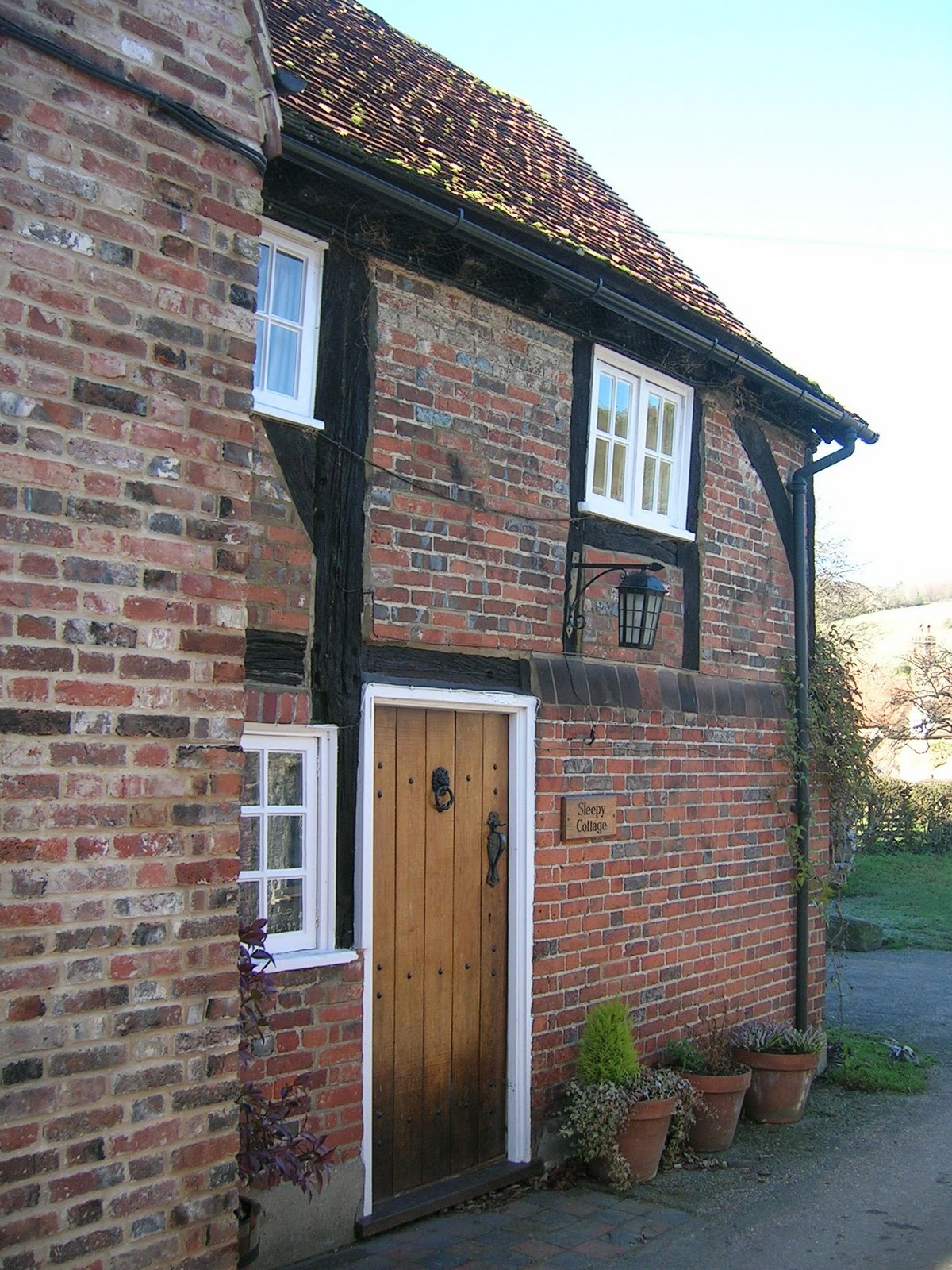
After leaving the church we walked up and down the only street in Turville looking for the exact locations of Harry and Geraldine's encounters. Then we went up the alley of the Sleepy Cottage and... here's the red door! The Sleepy Cottage is actually the name of the first little house in that alley but we immedialtely recognized our "Sleepy Cottage", the one inhabited by the handsome stranger.


We went up the hill following a muddy path in a small grove and here we are in the open space of the beautiful hilly landscape all around the village. Silence, cows and horses, the blue sky and the green grass.  There was even the hole in the mud where Geraldine jumped into! Where was Harry, then?


Some photos of the odd wooden bench we had immediately recognized on our arrival, then to the pub!  


What about a bite of supper? Well, we had lunch. But it was exactly there, where Harry and Geraldine had  supper on their first date. "You're looking lovely ... I reckon you're a teacher ... "  We were so close to the square hole in the wall in front of which the little table for two had been put! The pub has been refurbished and the counter /bar has been moved but it was IT! It was THE PUB!
We had delicious fish and chips and a lager. Finally, at 2 p.m. it was time to go. Our taxi driver was back to fetch us.


Good-bye, Turville. Good-bye, Dibley. We really hope they will take the wrapped scenery  (they didn't burn on Richard's suggestion)  out for other special episodes on the Vicar and her husband's married life.
As for us, we  are back home and go on dreaming  of winning the lottery to be able to  buy a cottage in Turville as well as a flat in London. Who knows? To dream costs nothing.

A very good weekend to you all!
MG