Showing posts with label Writing. Show all posts

09/07/2017

UNCONVENTIONAL KNOWLEDGE ABOUT WRITING THAT YOU CAN'T LEARN FROM BOOKS


(from guest blogger Mia Stokes)  Experience is best when it’s gained on your own. When you go through all the troubles and make your way through a certain problem, there is no better way to gain experience. Still, some knowledge we gain from other people. It’s not a bad practice to learn from other people, it gives us a better perspective occasionally. My writing career started out small and I had to learn from conventional sources in order to see where I want to go. But this road led me through some rather unconventional knowledge, some of which I’m going to share with you today.

07/11/2016

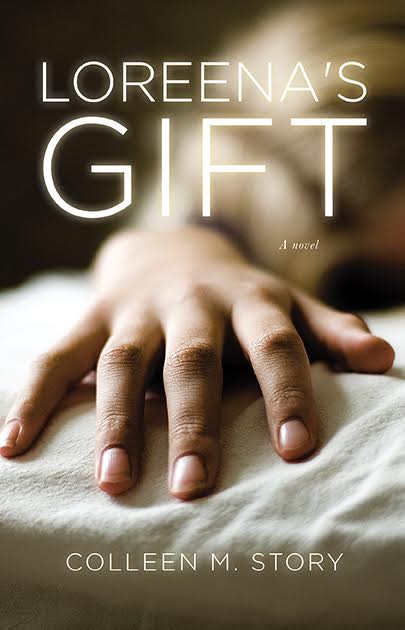
LOREENA'S GIFT BLOG TOUR - AUTHOR COLLEEN M. STORY: 3 THINGS YOU CAN'T TEACH ABOUT WRITING


A BLIND GIRL'S TERRIFYING "GIFT" ALLOWS HER TO REGAIN HER EYESIGHT--BUT ONLY AS SHE FERRIES THE RECENTLY DECEASED INTO THE AFTERLIFE.

Loreena Picket thinks she knows herself. A blind young woman who lives with her uncle, a reverend at a small-town church, she's a dutiful niece and talented pianist for the congregation.

But they're both hiding a terrible secret. Loreena can kill people with the touch of her hand.

While her uncle sees her as an angel of mercy, helping usher the terminally ill members of his flock into the afterlife, Loreena has her doubts.

Torn between doing her uncle's bidding and the allure of the fleeting moments when her eyesight returns on the journey to the other side, Loreena cooperates with her uncle until her troubled older brother returns to town. When she reveals her power by saving him from a local drug dealer, she is drawn into a sinister and dangerous world that will test the true nature of her talent and force her to consider how far she is willing to go to survive.

An exciting debut that crosses fantasy and literary fiction, Loreena's Gift is a thought-provoking meditation on life and death and what ultimately lies beyond this world.

* Loreena’s Gift was recently named 1st place fiction in the 2016 Idaho Author Awards *

​

Buy the Book:  Amazon  ~  Barnes & Noble  ~  Book Depository  ~  Chapters Indigo

26/08/2016

ARE YOU A WRITER? HERE'S TOP BOOKS TO AMP UP YOUR WRITING SKILLS


(by guest blogger Rachel Bartee) If you want to be a successful writer, there’s no room for stagnation. You must continuously learn new stuff and improve your writing skills. Your style and the quality of your content is greatly influenced by how much time you put into your personal development. Every successful writer, no matter the writing genre, got to where he is now by consistently crafting his writing skills through various methods.
As a writer for Edugeeksclub, constantly having to improve myself in order to keep up with the requirements, I’ve figured out many techniques on how to improve myself and my writing.

One of the most efficient ways writers use in order to improve their quality of writing is quite simple. They read. There are so many helpful books that are written with one purpose in mind: educating and training novice writers. They’re extremely specific and they’re offering a lot of useful and on-topic information concerning writing styles, grammar, writing tricks, and so on. In today’s article, we’ll take a look at the top eight books that can take your writing to the next level:

#1 On Writing Well: The Classic Guide to Writing Nonfiction by William Zinsser                  


This book is dedicated to everyone who wants to improve their writing. It’s a collection of well-written essays, along with in-depth analytics and explanations. It is not a technical book which offers step-by-step processes!
It offers a lot of great tips and insights, shows you many mistakes that you’re currently doing, and gives you the necessary tools to correct and improve your writing. It’s more about non-fiction writing rather than other genres. If you’re looking for those small details that can do a lot, this is the book for you.

27/07/2016

NANETTE LITTLESTONE, IF WISHES WERE HORSES


What’s your wish?

When I was a girl I wished for a pony. My wish was impractical as I lived in the city, had nowhere to keep a horse, and no means of caring for it. But that didn’t stop me from wishing. I loved palominos, so I imagined a beautiful, small palomino that would be mine, all mine. And every birthday I was disappointed. After 10 years of wishing I gave up.

What I didn’t know then was that wishing is only part of the equation. A wish is a dream that your heart has. But to make that dream a reality requires effort. The first step is to visualize what you want. Then you put your dream into action. You take the appropriate steps to reach your goal. If I’d really wanted a pony, I would have visited a horse farm or two. Talked to the owner about caring for a horse. Understood the requirements for feeding, veterinary care, the needs of the horse. Researched places for boarding a horse. Spent time mucking out stalls and oiling saddles and hefting hay bales to see if that was really something I wanted to do.

So what’s your wish? Do you want to write a book? Get your book published? Be part of a collaboration? Create a book launch on Amazon?

It’s time to dust off your wish box. You can see your dream come true if you follow these steps: 

07/07/2016

INTRUSION BLOG TOUR - AUTHOR'S GUEST POST: ADVICE YOU'D GIVE TO PEOPLE LOOKING TO PUBLISH SHORT STORIES

The world of the short story is a varied and fascinating place right now. Experimental collections, flash fiction, connected stories that read like novels --all these can be found on the shelves of bookshops and libraries. A check of current on-line journals will show that published stories can be complex prose poems or traditional narratives with conventional plot, characters and story arc.  There’s a place for every kind of story.
Where does the novice start? First - read.  Read stories in new collections, on-line zines and literary journals and decide if your particular style of story fits comfortably anywhere.  It’s important to read at least one edition of a journal before submitting.
Then- check guidelines and submission periods. Some respected literary journals have a short submission window.  Submit outside of that time frame and your carefully crafted story will be ignored.  If there is more than a token fee to submit, think carefully before paying it, particularly if the journal does not pay writers. (The same applies to competitions: if the prize money is small it may not be worth paying a hefty fee to enter.)  
The market has shrunk in recent years for women’s fiction but some magazines still consider unsolicited submissions.  Try: – My Weekly, Woman’s Weekly, Take a Break, Best and Yours.

02/04/2016

ALWAYS BE WRITING

(by guest blogger John Montana) 

 Many times I hear writers say they are stuck or are in a writers slump, because no ideas are coming or they don’t know what to write. They want an original idea for a film that nobody has ever seen before. They want the next great original idea that rocks the film world. Some of them will wait for years for that inspiration for the next great film. Now…you might get angry with me for saying this, or you will probably vehemently disagree, but I don’t think this should be your goal. Of course it can be a dream that this happens, but most likely the story in some form has already been told before. Don’t sweat it!!! Really, don’t let it prevent you from writing. Just write… let the words just flow out of you. Edit it all later. Write gobble-dee-gook, write crap, write anything. Just! Write! You can worry about judging it after you are finished. 

When you are done you can go in and create a story that will inspire you to film. Think of it this way… A sculptor starts with a huge block of stone. This is your “gobble-dee-gook”. Then begin to slowly carve away the stuff that you don’t need. Carefully reveal the story you want to tell. In the end you will have something that you will be excited about putting on film. So don’t be obsessed with telling an original story or have an idea that nobody has thought of before. Because ninety nine times out of one hundred… its been done before. 

11/11/2015

NANOWRIMO - NATIONAL NOVEL WRITING MONTH: PRECIOUS TIPS

It’s National Novel Writing Month, and that means that writers around the world are working hard to write an entire book during the month of November. Congratulations to everyone who has taken on this challenge—it’s no easy task!
To help you with your masterpiece-in-progress, Grammarly compiled a list of the most frequent writing mistakes they encountered as they edited their 2014 NaNoWriMo project, a crowdsourced novel called Frozen by Fire. When it’s time to proofread and revise your manuscript, make sure to watch out for these common pitfalls.

09/10/2015

HAVE YOU WRITTEN A STORY? NOW SEE IF IT'S THE WORLD'S BEST!


2015 CONTEST!
Writers submit your Story
Enter for a chance to join the House of transmedia stories company


What is World's Best Story?

"This is not just a literary contest, we're looking for stories that will be consumed in multiple media formats – from books to the big screen and beyond," says Vincent Salera, founder of World's Best Story. "Our goal is to revolutionize the traditional literary contest and identify a story with blockbuster appeal. We're looking for a story that audiences will love and help authors turn that story into trans-media franchises, which is why we're empowering readers to judge the contest."

How does it work?

Readers will vote for stories and awarded judges will declare the final Top 10 winners.

09/09/2015

GIORGIA HILL, AUTHOR OF "WHILE I WAS WAITING": WHAT COMES FIRST? THE STORY OR THE RESEARCH?

Tricky – in so many ways. If you write you have to do some, even if you’re following the well-worn adage, ‘write what you know.’ If you write fiction with any kind of historical content, then you have to do some.

What comes first? The story, or the research?
In my case, it’s the story.
Most of the time.
I write a very basic, very rough first draft and then research what I need to make it live - to make it feel authentic. I was asked recently at a writers’ event how I made my writing feel of the period it’s set in. I couldn’t really reply. I suspect the questioner wanted an easy solution, or a pat answer. Sadly, it involves a lot of reading, a lot of leg-work and a lot of browsing on the internet. There’s no short-cut. It helps, of course, if you have some prior knowledge and an interest in the period in which the book is set. I believe you also have to love that time in history. To use an over-used phrase, it must be a passion.
When writing While I Was Waiting, which is partly set during World War 1, certain things resonated. A visit to a nearby stately home set up an ‘experience room’ based around the time the three sons of the house were fighting at the front. On the mantle-piece was a photograph. They were posed in front of the house, sitting on their glossy horses, looking impossibly glamorous and waiting for the hunt to begin. Horses and men both full of vigour and energy. Four short years later all three brothers were dead, killed in action, in service of their country. That photograph haunted me for a long time and I included a similar experience in the book.

09/06/2015

HOLIDAY ROMANCE WRITING CONTEST


Do you like writing?  Here is a new chance for you to get published or win money! Meryton Press is conducting a contest to find the best short stories. The theme of the contest, “Holiday Romance,” represents the season from Thanksgiving to New Year's Day. The interpretation of the theme is left to the writer’s imagination; the story may have the season as an incidental backdrop or may highlight the warmth and goodwill of the holidays. It may be a romance set entirely before a fire on a cold winter’s night, the plight of a young couple hosting their first family Thanksgiving, or the mystery of an anonymous holiday philanthropist with a reporter hot on his tale. So many holidays, so many stories: Thanksgiving, Christmas, the Winter Solstice, Kwanzaa, Hanukkah, Boxing Day, New Year's Eve…
Any genre is acceptable as long as there is ROMANCE. Austenesque is a plus but is not required. In other words, so long as there is a commonly accepted or acceptable interpretation of the theme embedded in the plot, it works for us. However, this contest is not for children’s stories. Our target audience is readers over 18 years old.
The contest will be open for submissions from 9:00 a.m., June 15, 2015 (US Pacific Time) until 11:59 p.m., July 15, 2015 (US Pacific Time)

27/02/2015

DO WOMEN WRITE BETTER THAN MEN?


I don't particularly agree with stereotyped considerations and cliches or generalizations, but this survey proposed by grammarly.com sounds interesting. Have a look and feel free to share your opinions and comments below. Do women write better than men?

16/02/2015

JEFFREY PERREN, THIS WRITER'S LIFE - MEET THE AUTHOR OF COSSACKS IN PARIS


Up before dawn — tea for me, coffee for the wife, pet the dog. Check emails, correspondence with beta readers, and miscellaneous.

So far, that doesn’t sound very exciting. But that’s the business side of things. I leave as much of that as I can to my publicist — remembering how blessed I am to have one who loves my work.

Later, write or edit the latest story. It will be a re-telling of the William Tell legend and later a trilogy set in the Age of Discovery.

02/02/2015

MERYTON PRESS SHORT STORY CONTEST - SUMMER LOVIN'


BEGINS – 9:00 a.m. Feb 1, 2015 (US Pacific time)
ENDS – 11:59 p.m. March 15, 2015 (US Pacific Time)
Meryton Press is conducting a contest to find the best short stories.
The theme of the contest, “Summer Lovin’,” represents the summer season. The interpretation of the theme is left to the writer’s imagination; the story may have summer as a backdrop or may convey a sense of happiness and light. It might be a romantic comedy set in the South Pacific, a thriller in the everglades of Florida, a romance in Queen Victoria’s summer court, an ode to the ocean and Elizabeth Bennet, or a mail -order bride in the Old West—anything your summer muse suggests.
Any genre is acceptable as long as there is ROMANCE. Austenesque is a plus, but is not required. In other words, so long as there is a commonly accepted or acceptable interpretation of the theme embedded in the plot, it works for us. However, this contest is not for children’s stories. Our target audience is readers over 18 years old.
The contest will be judged by a panel of independent judges, and the results will be announced by mid-April 2015.

28/08/2014

HOW TO USE BOOKS TO WRITE ACADEMIC ESSAYS

Hello! I'm Eileen Archer and I'm here at FLY HIGH  as Maria Grazia's guest blogger. My post is a short guide for those who use books as part of their academic pieces of work. 

Why should I use books?
To write academically and correctly we must make use of the literature available to us. You must read as much as you possibly can before even starting to write your academic piece. Take notes of each book you have thought interesting and the relation between that and your own forthcoming work. Remember to mark the pages too, so you can come back to ideas later.

Which books?
When it comes to using the information from a book that you have absorbed, been interested in or found highly relevant to your field, you must decide when and where to use it. If there are two books that have the same idea, choose the one that clarifies the point better, and cite that one in your own piece of work. The clearer the idea, the easier it is for you to expand on the point and the easier it is for the reader to follow.

20/08/2014

IS A PARENT'S JOB EVER REALLY DONE? AN INTERVIEW WITH AUTHOR DEBORAH RANEY ABOUT HER "HOME TO CHICORY LANE"

Home to Chicory Lane 

Deborah Raney writes a story that examines how the love of our family can help us weather life's storms. The first book in the new Chicory Inn series introduces us to Audrey Whitman, a mother who has launched all of her children into life and now looks forward to fulfilling some of her own dreams during her empty-nest years. However, not all of her children are ready to stay out of the nest quite yet.

Raney has beautifully captured the tenderness - and turmoil - of family life in her new release. It was easy for her to do. "We have four grown children and five grandchildren . . . so far!" Raney says."So, as you can imagine, family is extremely important to us. We're both close to our families, and all of the good, the bad, the ugly, the wonderful of being part of a family, went into this series."

Readers of Home to Chicory Lane will meet all of the Whitmans, including Audrey and her husband, Grant, who are turning their beloved family home into a bed and breakfast. As Audrey works toward opening weekend, she is more than a little anxious, even as she joyfully anticipates her family and friends gathering from across the country to help celebrate the occasion.

What she doesn't expect is her youngest daughter, the newly-married Landyn, to arrive with a U-Haul, clearly intending to stay more than just a few days. Questions flood Audrey's mind: What happened in New York that sent Landyn running home? Where was Landyn's husband, Chase? It appears the Chicory Inn will be getting off to a bit of a rocky start.

11/07/2014

WRITERS & ACTORS - A HALF SERIOUS, HALF BORING REFLECTION ON WHY I AM FASCINATED BY THEM

Richard Armitage as John Proctor in The Crucible
There are two kinds of people I am particularly fascinated by, writers and actors. Not for the glamour surrounding them. In fact, I'm not interested in the extremely popular ones, the very famous. Honestly, I'm more attracted to their jobs, than to their popularity or personal life. I consider good acting and good writing the result of meticulous craftsmanship, artistry and, only rarely, art. I'm particularly drawn to these two categories of people, widely known or not,  since their professions are somewhat magical to me. 
They've got the power to create life, to give life through words.

I know actors use their whole bodies, so , let's say, mostly through words. Most of an actor's job is based on words, and they are very often essential to the achievement of the main goal: a successful performance. 


Meeting author Fabio Stassi 
Writers and actors create life through words, they give life to characters, and characters do not only represent people, they are people once the actors lend them their bodies and voices.

I love to think  that , more than stories, actors and writers create personae (persons in Latin, characters in English)  and they,  the characters, interacting, contribute their story. They are not mere fiction, they are not unreal. They live,  and they live on long in certain cases,  in our minds and hearts. Longer than the human being who created them. 

As for actors, once they are in a movie, for instance,  they never actually die. The go on living in their characters, in those frames. They go on giving them life and voice. So long as men can breathe, or eyes can see ... in Shakespeare's words.

20/04/2014

IN WAR THE WORDS OF A POET CAN SAVE LIVES, IN LIFE THE WORDS OF A POET CAN MAKE THE DIFFERENCE: MEETING ERRI DE LUCA

"... in war the words of a poet can save lives ...
in war the orphans and those without a book have no refuge"  

Erri De Luca's original first name was Henry, an homage to his grandmother, who had American nationality, but defined by him as an "accident". He eventually decided "to change" few letters by Italianizing his name as Erri. 
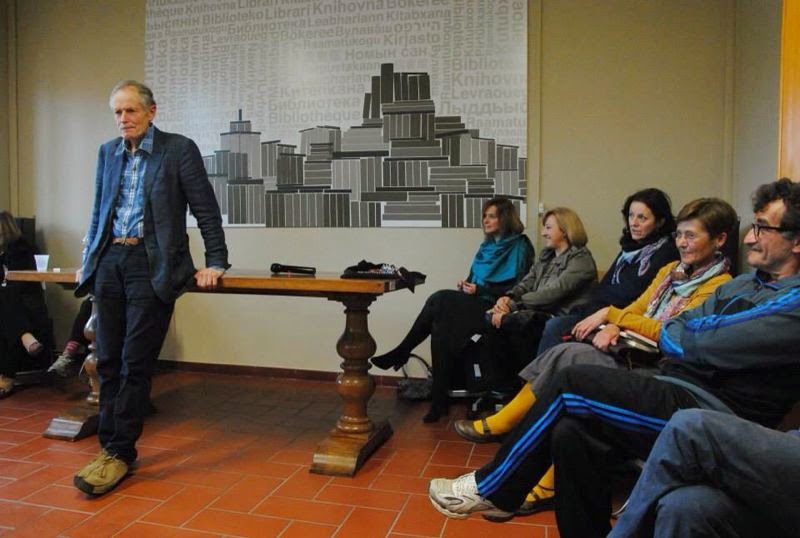
Meeting Erri De Luca at the library in my town a few days ago was something unexpectedly important.
Do you know when you have the impression that a person speaking to an audience is instead speaking to you, just to you, that those words are meant for you?
Strange enough, especially because I couldn't see his face (see picture, I'm sitting on the right). But that is what I felt sitting behind,  right behind him, behind that table on which the widely popular and highly appreciated Italian author was informally sitting while talking to us. I was at his back and could watch his shoulders slightly bent forward, his slim figure in a comfortable blue suit, moving to the rhythm of his placid voice and turning left, then right, to direct the blue-eyed piercing stare to each and every one facing him.

24/02/2014

MEET SIMON LEWIS, WRITER.

I’m very pleased to introduce my guest today: British novelist and screenwriter, Simon Lewis. I’m reading his novel GO these days and it is such a gripping thriller! My review of the book is coming soon, meanwhile, meet its brilliant author, please.
Simon Lewis was born in Wales in 1971 and GO is his first novel (1999), a travel thriller about backpackers, which he wrote  in a village in the Himalayas. It has been translated into German, Italian, Turkish and Swedish so far.
His second novel, BAD TRAFFIC (2008), is a crime thriller about people smugglers, featuring jaded Chinese cop, Inspector Jian. The book has been published in the UK and the US and translated into German, French, Swedish, Italian, Japanese and Turkish. In 2009 it was nominated for the LA Times Book of the Year Award and for the French SNCF prize for crime fiction.
His third travel thriller, BORDER RUN, was published in April 2012 in the US and the UK.
 As a screenwriter, Simon has worked for Potboiler Films, Cloud 8 and Channel 4 and has 3 movies with incredible International casts  in post-  or in production in 2014!  Read the interview, welcome Simon Lewis  at FLY HIGH and discover more about him and his work.


04/01/2014

WORDS, WITCHES & WOES

A movie, a book and bits of my real life are the topics of my  first post in the New Year. Let's hope it is a good one, without any tears. What? ... Yes, those words are not mine.


1. A Movie: The Words 

Plagiarism, writing, life and fiction ...The Words. I've seen this movie a few times in the latest weeks since it is running on my satellite TV channels. I was attracted by the title first and started watching it without knowing much about cast and plot. Positively surprised at discovering it was about writing, writers and books, I went on watching,  discovering one by one its protagonists: Dennis Quaid, Bradley Cooper, Jeremy Irons and Ben Barnes.
I liked it very much! Have you seen it?

06/12/2013

CREATIVE STRATEGIES THAT WILL KICK-START YOUR BOOK WRITING PROJECT

(by guest blogger Candace Meyer) Writing a book is one of the goals of aspiring authors and bestseller writers. To be able to create a really good book is already an achievement how much more if you were given a book contract and somebody wants to publish your work. If you want to enter in the world of book writing business, you have to be prepared mentally, physically, emotionally, and psychologically. Why? It is because learning how to write a book effectively is already a daunting task. Keep moving, editing your writing, and working with editors and publishers are another big challenges.


Before you jump-start your book writing project you have to ask yourself first, "Why write a book?". As a writer, it is important that you know your purpose and objectives of why pursuing such big writing project. Most writers think that writing a book is a hard work. It requires a lot of time and it takes a really long time before you can see the final product. Aside from that, there's always risks and one of which is that there might be no one who will read it. But why would you think of those not-so-good things if your goal is focused to successfully finish a good book, right? Instead of being pessimist, why not get your creative juices flowing and start working on it.